
The rapid advancement of electrification in the automotive sector has ushered in a new era of vehicle architectures. Among these, the battery electric vehicle with distributed drive configuration represents a significant technological leap. This architecture, where electric motors are integrated directly into the wheel hubs, offers superior advantages in traction control, energy efficiency, and vehicular dynamics. However, the shift from traditional internal combustion engine vehicles to this novel battery electric vehicle paradigm introduces new and complex interactions with road infrastructure, fundamentally altering the load environment at the tire-pavement interface.
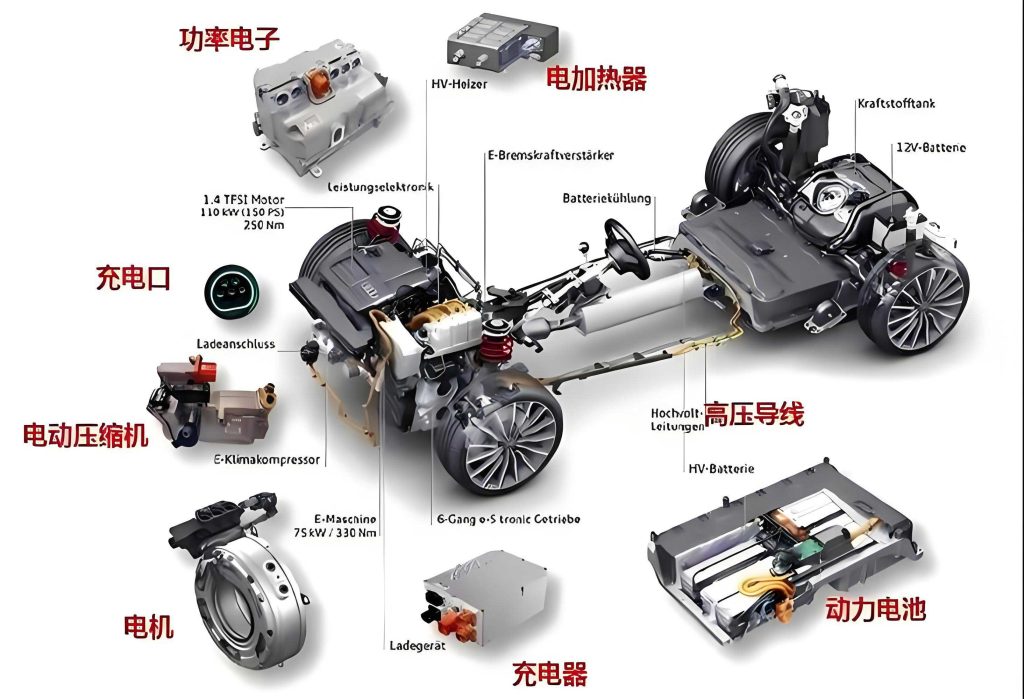
The core of the challenge lies in the hub motor unit itself. In a distributed drive battery electric vehicle, the hub motor adds significant unsprung mass to the wheel assembly. Furthermore, during operation, the electromagnetic interactions within the motor can generate dynamic forces, including a vertical electromagnetic force component. These factors—increased static load due to mass and dynamic excitation from electromagnetic activity—combine with traditional road roughness to create a distinct and potentially more severe loading regime on asphalt pavements. Understanding this regime is critical, as the contact stress distribution directly influences pavement distress modes such as rutting, fatigue cracking, and surface wear. Therefore, a detailed investigation into the tire-pavement contact mechanics for this new generation of battery electric vehicle is not just beneficial but essential for sustainable road design and vehicle development.
To this end, I established a high-fidelity, coupled full-vehicle and pavement finite element model. This integrated model encompasses the vehicle’s sprung mass, suspension, tires, hub motors, and a multi-layered asphalt pavement structure. The material behavior was carefully represented: the tire rubber was characterized using the Yeoh hyperelastic model, while the viscoelastic nature of the asphalt layers was captured using a Generalized Maxwell model, with time-temperature dependence addressed via the Williams-Landel-Ferry (WLF) equation. This comprehensive approach allows for the quantitative analysis of how the unique attributes of a distributed drive battery electric vehicle influence the three-dimensional state of stress at the critical contact patch.
Mathematical Modeling of the Vehicle-Road Coupled System
The dynamic tire force, which serves as the primary input to the detailed finite element model, is derived from a simplified yet representative mechanical model of the vehicle-road interaction. The road profile, a key excitation source, is generated as a function of time using the harmonic superposition method based on a prescribed power spectral density:
$$Z(t) = \sum_{i=1}^{N} \sqrt{2G_q(f_{\text{mid}_i}) \Delta f_i} \sin(2\pi f_{\text{mid}_i} t + \theta_i)$$
where \(Z(t)\) is the road surface elevation, \(G_q\) is the power spectral density, \(f_{\text{mid}_i}\) and \(\Delta f_i\) are the center frequency and bandwidth of the \(i\)-th frequency interval, and \(\theta_i\) is a random phase angle uniformly distributed between \(0\) and \(2\pi\).
The distributed drive battery electric vehicle is modeled as a quarter-car system, incorporating the unique mass and force contributions of the hub motor. The pavement is idealized as a finite-length Bernoulli-Euler beam resting on a Kelvin-Voigt viscoelastic foundation. The equations of motion for this coupled system are:
$$m_s \ddot{y}_s + k_s (y_s – y_u) + c_s |\dot{y}_s – \dot{y}_u|^{1.25} = 0$$
$$(m_u + m_{hm}) \ddot{y}_u – k_s (y_s – y_u) + k_t (y_u – q – y_r) – c_s |\dot{y}_s – \dot{y}_u|^{1.25} = F_d$$
$$EI \frac{\partial^4 y_r}{\partial x^4} + K y_r + C \dot{y}_r = F \delta(x – x_t)$$
The dynamic tire force \(F\) transmitted to the pavement is then:
$$F = k_t (y_u – q – y_r) – (m_s + m_u + m_{hm})g$$
where \(m_s\), \(m_u\), and \(m_{hm}\) are the sprung, unsprung, and hub motor masses; \(y_s\), \(y_u\), and \(y_r\) are the displacements of the sprung mass, unsprung mass, and pavement beam, respectively; \(k_s\) and \(k_t\) are suspension and tire stiffnesses; \(c_s\) is the suspension damping coefficient; \(q\) is the road roughness input; \(E, I, K, C\) are the pavement modulus, moment of inertia, foundation stiffness, and foundation damping; \(F_d\) is the vertical electromagnetic force; and \(g\) is gravity.
The parameters used for solving this coupled system to obtain the dynamic tire load are summarized in the table below.
| Category | Parameter | Symbol | Value |
|---|---|---|---|
| Vehicle | Sprung Mass | \(m_s\) | 350 kg |
| Unsprung Mass | \(m_u\) | 51.9 kg | |
| Suspension Stiffness | \(k_s\) | 35,714 N/m | |
| Tire Stiffness | \(k_t\) | 236,000 N/m | |
| Suspension Damping | \(c_s\) | 2,486.36 N·s/m | |
| Hub Motor Mass | \(m_{hm}\) | 51.9 kg | |
| Pavement Foundation | Beam Length | \(L\) | 7.5 m |
| Beam Thickness | \(h\) | 0.05 m | |
| Beam Modulus | \(E\) | 1.6 GPa | |
| Foundation Stiffness | \(K\) | 8.0 MN/m² | |
| Foundation Damping | \(C\) | 0.3 MN·s/m² |
Finite Element Simulation Framework
The dynamic tire forces calculated from the analytical model are applied within a sophisticated finite element environment to obtain detailed, spatially-resolved contact stresses. The full-vehicle model includes rigid bodies for the chassis and axles, and detailed deformable models for the tires and hub motors. The hub motor is bound to the tire inner liner, and the tire-wheel center is connected to the chassis via connector elements representing the suspension.
The tire is modeled as a composite structure using a Yeoh hyperelastic material model for the rubber components. The strain energy potential \(U\) for the Yeoh model is given by:
$$U = \sum_{i=1}^{N} C_{i0} (\bar{I}_1 – 3)^i + \sum_{i=1}^{N} \frac{1}{D_i} (J_{el} – 1)^{2i}$$
where \(\bar{I}_1\) is the first deviatoric strain invariant, \(J_{el}\) is the elastic volume ratio, and \(C_{i0}\) and \(D_i\) are temperature-dependent material parameters. The specific parameters for the tire model are listed below.
| Density (kg/m³) | \(C_{10}\) (MPa) | \(C_{20}\) (MPa) | \(C_{30}\) (MPa) |
|---|---|---|---|
| 1150 | 0.705 | -0.180 | 0.065 |
The pavement is modeled as a multi-layered system with a total dimensions of 50 m (length) × 7.5 m (width) × 5.0 m (depth). The viscoelastic response of the asphalt layers is critical and is modeled using a Prony series expansion of the Generalized Maxwell model. The relaxation modulus \(E(t)\) is expressed as:
$$E(t) = E_{\infty} + \sum_{i=1}^{n} E_i e^{-t/\tau_i}$$
where \(E_{\infty}\) is the equilibrium modulus, and \(E_i\) and \(\tau_i\) are the modulus and relaxation time of the \(i\)-th Maxwell element. The time-temperature superposition principle is applied using the WLF equation:
$$\log(a_T) = \frac{-C_1 (T – T_{ref})}{C_2 + (T – T_{ref})}$$
where \(a_T\) is the shift factor, \(T\) is the temperature, and \(T_{ref}\) is the reference temperature. The pavement structure and material properties are detailed in the following table.
| Layer | Material | Thickness (cm) | Modulus (MPa) | Poisson’s Ratio |
|---|---|---|---|---|
| Surface | SBS-modified Asphalt (AC-13C) | 4 | 10,500 | 0.25 |
| Intermediate | Rubber/SBS-modified Asphalt (ARHM-20) | 6 | 13,000 | 0.25 |
| Base | Asphalt Treated Base (ATB-25) | 8 | 9,500 | 0.25 |
| Subbase 1 | Cement Stabilized Aggregate | 18 | 1,500 | 0.25 |
| Subbase 2 | Cement Stabilized Aggregate | 18 | 1,500 | 0.25 |
| Subgrade | Natural Soil | ∞ | 45 | 0.40 |
Model Validation
The fidelity of the finite element modeling approach was confirmed through two physical validation tests. First, a tire radial stiffness test was conducted using a dynamic electro-hydraulic loading system. The tire was subjected to vertical loads from 1 kN to 6 kN in increments. The simulated load-displacement curve from the detailed FE tire model showed excellent agreement with the experimental data, with a calculated error in radial stiffness of less than 9%. This confirms that the tire model accurately captures the vertical stiffness characteristics critical for load transmission.
Second, the pavement material response and stress calculation methodology were validated. A slab of SBS-modified asphalt mixture was fabricated and instrumented with embedded stress sensors. A hydraulic actuator applied a dynamic load to the slab surface. The stress time-history recorded at the bottom of the slab was compared with the finite element simulation results under identical loading conditions. The error between the simulated and measured stress amplitudes was approximately 4.5%. These validation steps provide high confidence that the coupled vehicle-pavement FE model can reliably predict the mechanical response induced by a moving battery electric vehicle.
Analysis of Contact Stress Under Battery Electric Vehicle Loading
Using the validated model, I systematically analyzed the contact stress on the asphalt pavement surface under a distributed drive battery electric vehicle traveling at 60 km/h on a Class A road profile. The analysis focused on isolating and quantifying the effects of the two primary new factors: the hub motor mass and the vertical electromagnetic force.
The hub motor mass constitutes a permanent increase in the unsprung weight of the battery electric vehicle. This additional mass directly increases the static component of the tire load. Simulation results comparing a baseline case (without hub motor mass) to the case including the hub motor gravity show a clear increase in all contact stress components. The vertical contact stress, most critical for pavement rutting, experiences the most significant rise.
The operation of the hub motor introduces dynamic excitations. In a perfectly balanced motor, the net vertical electromagnetic force is negligible. However, manufacturing tolerances, wear, or assembly can lead to rotor eccentricity—either static or dynamic. This eccentricity breaks the symmetry of the magnetic airgap, generating an unbalanced magnetic pull (UMP), which manifests as a time-varying vertical electromagnetic force. I modeled both static and dynamic eccentricity conditions. The results indicate that even a small eccentricity (e.g., 0.1 mm) can generate a substantial oscillating vertical force with an amplitude several times higher than that of a balanced motor. This force acts directly on the unsprung mass, modulating the dynamic tire force and, consequently, the contact stress.
The most severe loading scenario for the pavement occurs when the static load from the hub motor mass is combined with the dynamic excitation from the electromagnetic force due to eccentricity. My simulations quantified the peak contact stresses under three scenarios: 1) Baseline vehicle (no added hub motor effects), 2) Battery electric vehicle with hub motor mass only, and 3) Battery electric vehicle with both hub motor mass and vertical electromagnetic force from static eccentricity. The results are summarized in the table below.
| Loading Scenario | Peak Vertical Stress (MPa) | Peak Transverse Stress (MPa) | Peak Longitudinal Stress (MPa) |
|---|---|---|---|
| Baseline Vehicle | -0.196 | -0.155 | -0.122 |
| With Hub Motor Mass | -0.230 | -0.161 | -0.134 |
| With Mass + Electromagnetic Force | -0.242 | -0.168 | -0.137 |
The analysis reveals the incremental impact of each factor associated with the modern battery electric vehicle. The addition of the hub motor mass alone increases vertical, transverse, and longitudinal contact stress by approximately 17.3%, 3.9%, and 9.8%, respectively, compared to the baseline. When the dynamic vertical electromagnetic force from an eccentric motor is superimposed on this increased mass, the stresses rise further. The combined effect leads to total increases of approximately 23.8% in vertical stress, 7.9% in transverse stress, and 12.5% in longitudinal stress relative to the baseline. This demonstrates that the operational state of a distributed drive battery electric vehicle can impose a significantly more demanding mechanical environment on the road surface than a conventional vehicle. The increased vertical stress is particularly concerning for permanent deformation (rutting), while the increased longitudinal stress may influence surface wear and skid resistance over time.
Conclusion
This investigation provides a comprehensive mechanical analysis of the tire-pavement interface under the loading of a distributed drive battery electric vehicle. Through the development and validation of a coupled full-vehicle and pavement finite element model, I have quantitatively isolated the effects of the distinctive features of this vehicle architecture. The key findings are that the hub motor contributes significantly to the unsprung mass, thereby increasing the static load on the pavement. More importantly, the electromagnetic forces generated during the operation of the motor, especially under conditions of rotor eccentricity, introduce an additional dynamic load component. The superposition of these two factors—increased mass and dynamic electromagnetic excitation—can elevate pavement contact stresses substantially, with vertical stress increasing by nearly a quarter under the analyzed conditions.
These results underscore a critical point for both the automotive and civil engineering industries: the transition to battery electric vehicle technology, and specifically to distributed drive configurations, alters the fundamental vehicle-infrastructure interaction. The additional load effect cannot be ignored in long-term pavement performance predictions. For vehicle engineers, this highlights the importance of optimizing hub motor design for minimal mass and excellent electromagnetic balance to mitigate these impacts. For pavement designers, these findings suggest that future design methodologies may need to account for the distinct loading signature of the growing fleet of battery electric vehicles to ensure the durability and longevity of road infrastructure. This work establishes a foundational framework for further research into the sustainable co-development of advanced electric vehicles and the road networks they utilize.