
In my analysis of modern transportation electrification, the lithium-ion battery stands as the cornerstone of the battery electric vehicle revolution. Its high energy density, long cycle life, and reducing cost have enabled the widespread adoption of electric mobility. However, my experience and extensive research into the field reveal a persistent and critical challenge: severe performance degradation at low temperatures. When a battery electric vehicle operates in or is exposed to cold climates, its lithium-ion power battery suffers from significant power attenuation, markedly prolonged charging times, and a heightened risk of lithium plating. These issues not only compromise the driving range and user convenience but also accelerate battery aging and, in extreme cases, can precipitate thermal runaway, undermining the fundamental safety proposition of the battery electric vehicle. Therefore, the development and optimization of efficient low-temperature heating technologies have become a focal point of my research and industrial application efforts to ensure the reliable year-round operation of battery electric vehicles.
The core of the problem lies within the battery’s internal electrochemical processes, which are highly temperature-dependent. My investigation into the performance衰退机理 (recession mechanism) identifies several interrelated factors. Primarily, the ionic conductivity of the electrolyte decreases dramatically as temperature drops. The viscosity increases, severely hampering Li+ ion transport. This relationship can be approximated by the Arrhenius-type equation:
$$\sigma_{electrolyte} = A \cdot e^{(-E_a / (R T))}$$
where $\sigma_{electrolyte}$ is the ionic conductivity, $A$ is the pre-exponential factor, $E_a$ is the activation energy for ion migration, $R$ is the universal gas constant, and $T$ is the absolute temperature. The exponential decay with decreasing $T$ explains the drastic fall in power capability.
Secondly, the kinetics at the electrode interfaces slow down. The charge transfer resistance increases, and the solid-state diffusion of lithium within the active material particles becomes sluggish. The Butler-Volmer equation illustrates the temperature dependence of the charge transfer current:
$$i = i_0 \left[ \exp\left(\frac{\alpha_a F \eta}{RT}\right) – \exp\left(-\frac{\alpha_c F \eta}{RT}\right) \right]$$
where $i_0$ is the exchange current density, which itself is a function of temperature ($i_0 \propto e^{-E_{a,ct}/RT}$). A lower $T$ drastically reduces $i_0$, requiring a larger overpotential $\eta$ to sustain the same current $i$, leading to voltage limits being hit prematurely.
Thirdly, the growth and increased resistance of the Solid Electrolyte Interphase (SEI) on the anode become more pronounced. At low temperatures and during charging, the anode potential can drop below the Li+/Li redox potential, leading to metallic lithium plating instead of intercalation into graphite. This plated lithium reacts with the electrolyte, forming more SEI, which consumes active lithium and increases impedance in a vicious cycle. The propensity for this is heightened by the slow diffusion, which can be modeled as a competition between intercalation and plating currents.
Finally, the most dangerous consequence is lithium dendrite formation. Uneven lithium deposition can lead to needle-like dendrites that may pierce the separator, causing an internal short circuit. The growth velocity of a dendrite tip can be related to the local current density and overpotential. The performance impact is stark, as shown in the following table summarizing power capability for a typical battery electric vehicle battery:
| State of Charge (%) | Discharge Power at 20°C (kW) | Discharge Power at -20°C (kW) | Percentage of 20°C Power (%) |
|---|---|---|---|
| 10 | 60 | 8 | 13.3 |
| 50 | 120 | 48 | 40.0 |
| 90 | 120 | 48 | 40.0 |
A similar drastic reduction is observed for charging power. This means a battery electric vehicle’s range can be halved in extreme cold, and charging times can triple, creating significant user anxiety and limiting the utility of the battery electric vehicle in cold climates.
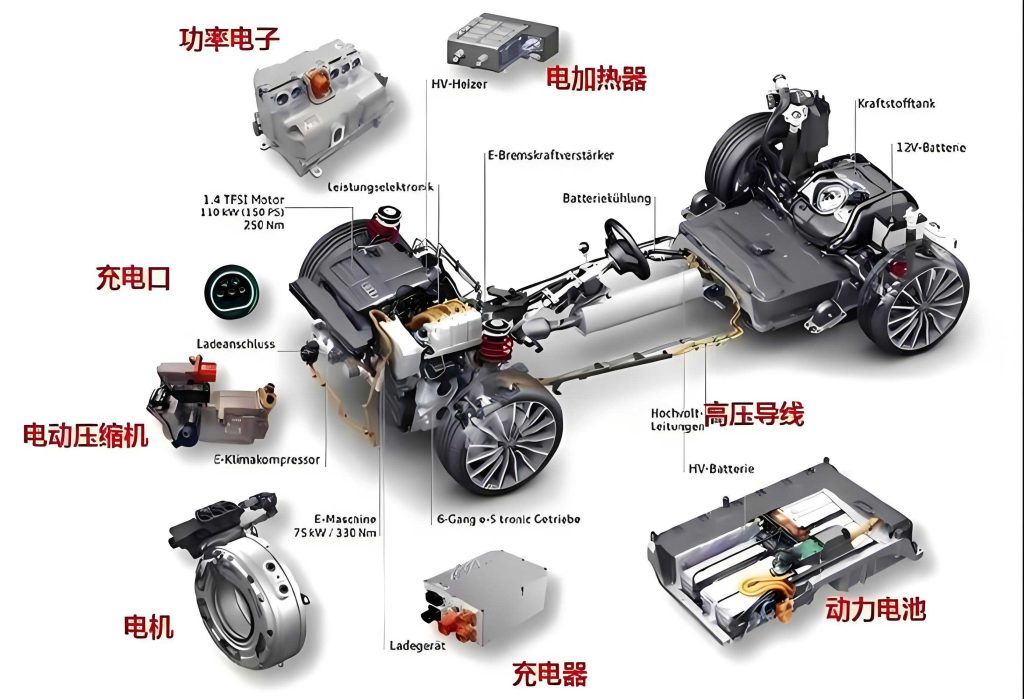
To combat these challenges, my review focuses on two principal heating philosophies: external and internal heating. Each category encompasses several technologies with distinct mechanisms, advantages, and trade-offs, crucial for the thermal management strategy of any modern battery electric vehicle.
External Heating Methods
External heating methods involve generating heat outside the battery cells and transferring it inward via conduction or convection. These are generally mature technologies integrated into many production battery electric vehicles.
1. Positive Temperature Coefficient (PTC) Heating
PTC heating utilizes ceramic materials (e.g., BaTiO3-based) whose electrical resistance increases sharply above a certain Curie temperature ($T_c$). The microscopic mechanism involves a phase transition from a ferroelectric to a paraelectric state, drastically reducing charge carrier mobility. The self-regulating behavior is its key feature. The power generated can be expressed as:
$$P_{heating} = \frac{V^2}{R(T)}$$
where $R(T)$ increases exponentially near $T_c$, causing $P_{heating}$ to drop and thus preventing overheating. It is often embedded in aluminum plates attached to the battery module. While safe and reliable, its main drawback is relatively low heating efficiency and significant energy consumption, directly impacting the range of the battery electric vehicle.
2. Heating Film/Foil Technology
This method employs flexible films with an embedded resistive layer (e.g., metal alloy, carbon-based). When a current $I$ is applied, Joule heating occurs uniformly across the film’s surface area $A$ in contact with the battery. The heat generation rate per unit area is:
$$q” = \frac{I^2 R_{film}}{A}$$
The film is laminated directly onto the battery surface, ensuring good thermal contact. The advantages include good temperature uniformity and faster response than PTC. However, long-term durability and potential aging of the adhesive or film material under thermal cycling are concerns for the lifespan of a battery electric vehicle.
3. Liquid-Based Heating
This is often integrated with the liquid cooling system of a battery electric vehicle. A coolant (e.g., water-glycol mixture) is heated by an external source like a PTC heater, a heat pump, or waste heat from the powertrain. The hot liquid is then pumped through channels in a cold plate attached to the battery. The heat transfer rate is governed by convection:
$$Q = h A (T_{fluid} – T_{battery})$$
where $h$ is the convective heat transfer coefficient, highly dependent on flow rate and channel design. Liquid heating offers excellent temperature uniformity and high heating efficiency. The primary challenges are system complexity (pumps, valves, pipes), risk of leakage, and the parasitic energy required to drive the pump and heater, which again affects the overall efficiency of the battery electric vehicle.
The following table provides a comparative summary of these external heating methods:
| Technology | Heating Principle | Key Advantages | Main Challenges | Typical Application in Battery Electric Vehicle |
|---|---|---|---|---|
| PTC Heating | Joule heating with self-regulating resistance | Inherent safety, simple control, reliable | Low heating rate, high energy consumption, uneven heating possible | Integrated into module sidewalls or dedicated heating plates |
| Heating Film | Joule heating in a thin resistive layer | Good temperature uniformity, flexible, fast response | Durability and aging, requires precise thermal interface | Directly laminated onto cell or module surfaces |
| Liquid Heating | Convective heat transfer from heated fluid | High heating rate, excellent temperature uniformity, integrable with cooling | System complexity, risk of leakage, parasitic power loss | Utilizes the existing liquid cooling circuit with an added heater |
Internal Heating Method: Pulse Heating
Internal heating represents a paradigm shift by generating heat directly within the battery cell through its internal resistance, thereby eliminating thermal conduction delays. The most prominent technique is pulse heating. In this approach, a high-frequency alternating current (AC) or a unidirectional pulsed current is applied to the battery. The heat is generated primarily by Joule heating due to the battery’s internal impedance $Z_{int}$:
$$P_{pulse} = I_{pulse}^2 \cdot R_{effective}$$
where $R_{effective}$ is the real part of the impedance (ohmic resistance + charge transfer resistance). A sophisticated implementation in a battery electric vehicle leverages the power electronics of the electric drive system. By strategically switching the inverter’s Insulated-Gate Bipolar Transistors (IGBTs), a pulsed current is circulated between the battery and the motor windings (acting as an inductor), generating heat directly inside the cells with minimal energy loss to external components.
The temperature rise can be estimated by:
$$\Delta T = \frac{1}{m C_p} \int I_{pulse}^2(t) R_{effective}(T, SOC) \, dt$$
where $m$ is the battery mass and $C_p$ its heat capacity. Pulse heating boasts remarkable heating rates (often exceeding 2-3°C per minute), superior temperature uniformity, and a simpler system architecture as it repurposes existing hardware in the battery electric vehicle. However, the major research challenge lies in optimizing pulse parameters (amplitude $I_{pulse}$, frequency $f$, duty cycle $D$) to maximize heating while minimizing detrimental side effects like accelerated degradation, lithium plating during pulse intervals, and capacity loss. The pulse current must be carefully controlled to stay within electrochemical windows that avoid anode potential dropping to the plating region. This optimization is critical for the long-term health of the battery in a battery electric vehicle.
Comparative Analysis and Technology Selection
My synthesis of these technologies leads to a clear comparative hierarchy for application in a battery electric vehicle. While external methods are well-established, pulse heating stands out for its performance. The key metrics are compared below:
| Performance Metric | PTC Heating | Heating Film | Liquid Heating | Pulse Heating |
|---|---|---|---|---|
| Heating Rate | Slow (~0.5-1°C/min) | Moderate (~1-2°C/min) | Moderate to Fast (~1-3°C/min) | Very Fast (2-8°C/min) |
| Temperature Uniformity | Poor to Moderate | Good | Excellent | Excellent |
| System Complexity | Low | Low | High | Low (uses existing drivetrain) |
| Energy Efficiency | Low | Moderate | Moderate | High |
| Impact on Battery Life | Low (if temperature controlled) | Low (if temperature controlled) | Low (if temperature controlled) | Requires careful parameter optimization |
| Technology Maturity | High | High | High | Growing / Commercializing |
The choice of technology also depends heavily on the battery format in the battery electric vehicle. For instance, cylindrical cells in dense modules may benefit more from liquid or heating film solutions for envelope heating. Large prismatic or pouch cells, with their larger flat surfaces, are well-suited for heating films or integrated liquid plates. Pulse heating, being independent of cell format, offers a universal solution but requires sophisticated battery management and power electronics control.
Future Research Directions for Battery Electric Vehicles
Despite progress, my perspective on the future of low-temperature operation for battery electric vehicles identifies several critical avenues for further exploration. First, the integration of multiple heating methods holds promise. A hybrid system could use a low-power PTC or film to pre-warm the battery to a safer threshold, after which ultra-fast pulse heating takes over to quickly reach the optimal temperature, balancing speed, safety, and efficiency.
Second, the development of advanced materials is fundamental. This includes electrolytes with lower freezing points and higher ionic conductivity at sub-zero temperatures (e.g., novel solvents, additives, solid-state electrolytes), as well as more efficient, durable, and higher-voltage-resistant heating elements for external methods.
Third, mitigating long-term degradation from heating, especially pulse heating, is paramount. Research must establish clear correlations between pulse parameters (magnitude, frequency, SOC window) and degradation modes (SEI growth, lithium plating, particle cracking). Multi-objective optimization frameworks are needed to find the Pareto-optimal trade-off between heating speed and cycle life for the battery electric vehicle.
Fourth, the path leads to intelligent and predictive thermal management. Leveraging cloud data, weather forecasts, and user driving patterns, the Battery Management System (BMS) of a connected battery electric vehicle could pre-heat the battery proactively before a scheduled departure or fast-charging session, maximizing convenience and battery health.
Finally, a holistic lifecycle and environmental perspective is essential. Heating systems must be designed considering their full environmental footprint, including the energy consumption that affects the well-to-wheel emissions of the battery electric vehicle and the recyclability of heating components at end-of-life.
In my concluding assessment, the advancement of low-temperature heating technologies is not merely an incremental improvement but a decisive factor in achieving global, all-climate viability for the battery electric vehicle. While external heating methods provide reliable solutions, internal pulse heating represents a transformative leap in efficiency and performance. The ongoing research and commercialization efforts in this domain are pivotal to eliminating “range anxiety” in winter, ensuring ultra-fast charging regardless of weather, and ultimately guaranteeing the safety, durability, and customer satisfaction that will cement the dominance of the battery electric vehicle in the future of sustainable transportation.