
From my perspective, the global shift toward electric vehicle car adoption is undeniable, and the backbone of this transition lies in robust charging infrastructure. I have observed with great interest the recent unveiling of the “Three-Year Doubling” action plan, a pivotal policy initiative designed to supercharge the development of electric vehicle car charging networks. This comprehensive strategy aims not only to expand the physical number of charging points but also to enhance their quality, intelligence, and accessibility, ensuring that the promise of electric vehicle car ownership is fulfilled for millions.
The current landscape for the electric vehicle car market is one of explosive growth. To quantify this progress, I have compiled key metrics that illustrate the scale and pace of adoption, which directly informs the urgency behind the new infrastructure push.
| Indicator | Value | Period/Reference |
|---|---|---|
| Total Electric Vehicle Car Population | 36.89 million units | Mid-2025 |
| Pure Electric Vehicle Car Population | 25.539 million units | Mid-2025 |
| Total Charging Points (Infrastructure) | 17.348 million units | August 2025 |
| Battery Swap Stations | 4,946 stations | August 2025 |
| Electric Vehicle Car Sales (Year-to-Date) | 11.228 million units | January-September 2025 |
| New Car Market Penetration Rate | 46.1% | January-September 2025 |
These figures reveal a rapidly maturing electric vehicle car ecosystem. However, my analysis indicates that the charging infrastructure has not kept perfect parity with this growth. Challenges such as geographical imbalance, with urban centers being better served than rural areas, and a relative scarcity of high-power charging options for electric vehicle cars, create friction for users. The core objective of the action plan is to rectify these disparities and future-proof the network. The plan’s overarching target for 2027 is clear: to construct 28 million charging facilities, deliver over 300 million kilowatts of public charging capacity, and adequately serve the charging needs of more than 80 million electric vehicle cars. This represents a doubling of service capability, a goal that can be expressed mathematically. If we denote the current effective service capacity as \( S_0 \) and the 2027 target as \( S_t \), the plan mandates:
$$ S_t \geq 2 \times S_0 $$
This simple equation belies the complexity of the undertaking, which is broken down into five coordinated专项 actions.
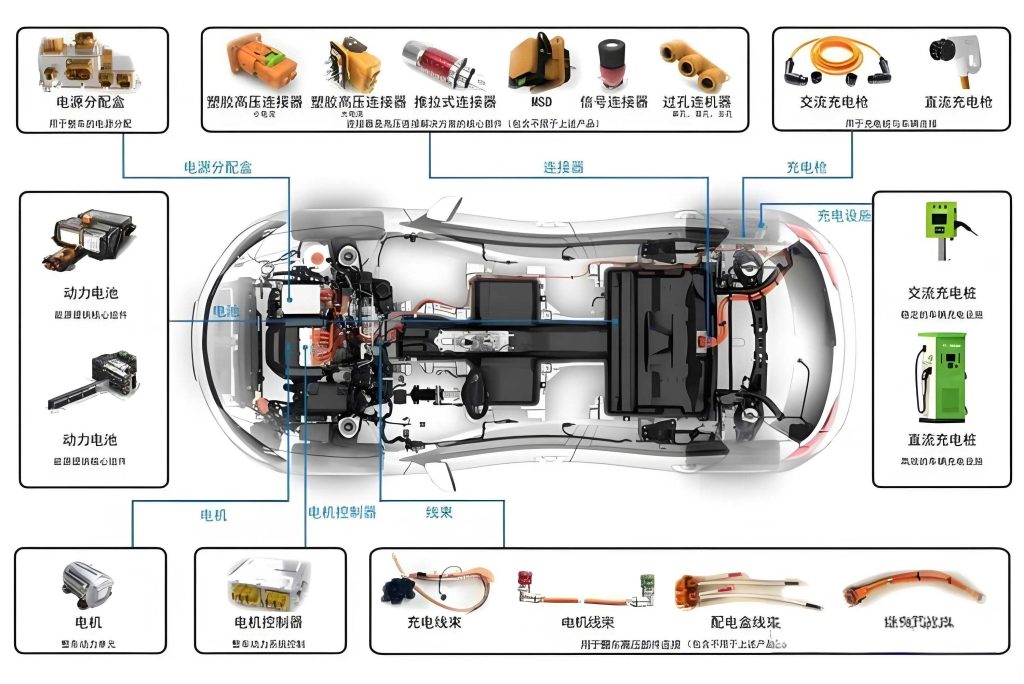
This image symbolizes the technological heart of the modern electric vehicle car charging experience, integrating hardware and software to deliver energy efficiently. The success of the plan hinges on executing five critical专项行动, each targeting a specific dimension of the electric vehicle car charging challenge.
The first action focuses on Public Charging Facility Enhancement. The strategy is to build a multi-tiered public network where fast charging is the primary option, slow charging provides auxiliary support, and high-power charging serves as a premium supplement. A significant component is the renewal of older, less efficient equipment. The quantitative targets for urban public charging are substantial, as summarized below.
| Public Charging Segment | Target by 2027 | Key Characteristic |
|---|---|---|
| Urban DC Charging Guns | 1.6 million new units | Fast and high-power focus |
| Urban High-Power Charging Guns | 100,000 new units | Ultra-fast charging for electric vehicle cars |
| Highway Service Area Guns | 40,000 new/upgraded units | Minimum 60 kW “fast-superfast combined” |
The rationale for prioritizing high-power charging for electric vehicle cars is rooted in user demand and efficiency. The charging time \( T \) for an electric vehicle car is inversely proportional to the charging power \( P \), given a battery capacity \( E_b \):
$$ T = \frac{E_b}{P} $$
For a typical electric vehicle car with a 75 kWh battery, upgrading from a 50 kW charger to a 300 kW charger reduces the theoretical charging time from 1.5 hours to just 0.25 hours (15 minutes). This dramatic improvement addresses a major pain point for electric vehicle car owners. The plan also specifically targets highway corridors and rural areas. In rural townships currently lacking public charging, the goal is to deploy a minimum of 14,000 DC charging guns, ensuring basic access for electric vehicle car owners and supporting initiatives like electric vehicle car adoption in countryside regions.
The second action, Residential Charging Condition Optimization, tackles the “difficulty of installing home chargers.” The plan mandates that 100% of parking spaces in new residential areas must have charging facilities or pre-installation conditions. For existing communities, it promotes retrofitting through neighborhood renewal projects. A key operational model is the “unified planning, construction, and operation” approach, aiming to establish 1,000 pilot communities by 2027. This model can reduce individual hassle and improve safety for electric vehicle car home charging.
The third and highly innovative action is Vehicle-Grid Interaction (V2G) Promotion. This transforms the electric vehicle car from a mere energy consumer into a mobile energy storage asset for the grid. The plan sets a target of deploying over 5,000 bidirectional charging (V2G) facilities, facilitating reverse discharge exceeding 20 million kWh. The potential grid support can be modeled. If \( N_{V2G} \) represents the number of V2G-capable electric vehicle cars, each with an average battery energy capacity \( B_{avg} \) (kWh), the total theoretical energy storage potential \( E_{store} \) available to the grid is:
$$ E_{store} = N_{V2G} \times B_{avg} $$
Furthermore, the economic value for an electric vehicle car owner participating in V2G can be estimated. Let \( P_{discharge} \) be the discharge power, \( t \) the discharge duration, and \( r_{price} \) the price rate for electricity sold back to the grid. The revenue \( R \) generated is:
$$ R = P_{discharge} \times t \times r_{price} $$
This creates a financial incentive while providing crucial grid services like peak shaving and frequency regulation, making the electric vehicle car ecosystem more sustainable and integrated.
The fourth action, Power Supply Capacity Improvement, addresses the foundational electrical grid support required for dense electric vehicle car charging. It requires the integration of future charging load forecasts into distribution network planning. In areas with constrained power capacity, technological solutions like power pooling and advanced management are essential. The efficiency \( \eta \) of a charging station’s use of grid capacity can be defined as the ratio of effective charging power output \( P_{out} \) to the allocated grid input capacity \( P_{in} \):
$$ \eta = \frac{P_{out}}{P_{in}} $$
Innovative systems have demonstrated that high \( \eta \) values (e.g., above 90%) are achievable, meaning more electric vehicle cars can be charged quickly without requiring proportionally massive grid upgrades. This is vital for deploying high-power charging hubs in urban cores or along highways where grid capacity is often limited.
The fifth action, Operational Service Upgrade, focuses on the user experience and backend management. This includes simplifying application procedures, promoting online service platforms, and ensuring reliable maintenance. For the electric vehicle car owner, seamless, hassle-free access to charging is as important as the hardware’s existence.
To understand the scale of the planned expansion, we can model the growth trajectory. Starting from a base of approximately \( C_0 = 17.35 \) million charging points in mid-2025, the target for end-2027 is \( C_t = 28 \) million. Assuming a compound annual growth rate (CAGR), we can solve for \( r \):
$$ C_t = C_0 \times (1 + r)^n $$
Where \( n = 2.5 \) years (approximating from mid-2025 to end-2027). Solving for \( r \):
$$ r = \left( \frac{C_t}{C_0} \right)^{\frac{1}{n}} – 1 \approx \left( \frac{28}{17.35} \right)^{0.4} – 1 \approx 0.20 $$
This indicates an required average annual growth rate of around 20% in the number of charging points, a challenging but achievable target given the policy push.
The total energy demand from the growing fleet of electric vehicle cars is another critical metric. A simplified model for estimating the daily national charging energy demand \( E_{daily} \) is:
$$ E_{daily} = N_{EV} \times \bar{d} \times \bar{e} $$
Here, \( N_{EV} \) is the total number of electric vehicle cars, \( \bar{d} \) is the average daily distance traveled per electric vehicle car (km), and \( \bar{e} \) is the average energy consumption per kilometer (kWh/km). If we project for 2027 with \( N_{EV} = 80 \) million, \( \bar{d} = 40 \) km, and \( \bar{e} = 0.18 \) kWh/km, then:
$$ E_{daily} = 80 \times 10^6 \times 40 \times 0.18 = 576 \times 10^6 \text{ kWh} = 576 \text{ GWh} $$
This colossal daily energy requirement highlights why the plan’s focus on capacity (300+ million kW) is essential to meet peak charging periods without congestion.
The technological evolution of charging for electric vehicle cars is also accelerating. The table below contrasts the primary charging tiers relevant to the plan’s focus.
| Charging Tier | Typical Power Range | Approx. Time for 400 km Range* | Primary Role in Network |
|---|---|---|---|
| Standard AC (Slow) | 3.7 kW – 22 kW | 8 – 14 hours | Residential, workplace, long-duration parking |
| DC Fast Charging | 50 kW – 150 kW | 30 – 60 minutes | Public urban hubs, highway service areas |
| High-Power DC Charging | 150 kW – 350 kW | 15 – 25 minutes | Key urban corridors, dedicated charging parks |
| Ultra-High-Power DC Charging | 400 kW and above | 10 minutes or less | Premium demonstration sites, future-proofing |
*Assumes an electric vehicle car with an energy consumption of 16 kWh/100km and a 64 kWh battery. The time \( T \) is estimated using \( T = (E_b / P) \times \phi \), where \( \phi \) is a factor accounting for charging curve taper (typically 0.8-0.9 for estimation).
The economic and industrial implications of this action plan are profound. Sectors involved in manufacturing high-power charging equipment, developing vehicle-grid interaction technology, and executing power grid upgrades will experience significant demand surges. The push for more electric vehicle car charging infrastructure creates a positive feedback loop: better infrastructure reduces range anxiety, boosting electric vehicle car sales, which in turn justifies further infrastructure investment. From my viewpoint, this plan is not merely about building chargers; it is about catalyzing a holistic ecosystem where the electric vehicle car is a fully integrated, convenient, and intelligent component of both the transportation and energy systems.
In summary, the “Three-Year Doubling” action plan represents a monumental and necessary step in the journey toward widespread electric vehicle car adoption. By addressing quantitative expansion, qualitative enhancement, geographical equity, and technological innovation simultaneously, it lays a formidable foundation. I am convinced that successful implementation will not only secure the energy future for millions of electric vehicle cars but also demonstrate how forward-thinking infrastructure policy can accelerate a sustainable transportation revolution. The continued iteration and evolution of such plans will be critical as the electric vehicle car market itself continues to evolve and grow.