
As a researcher and practitioner in the field of electric mobility, I have witnessed the rapid proliferation of battery electric cars and the consequent higher demands on charging infrastructure. In my view, charging stations, as critical nodes in the energy supply network, directly impact user experience and the overall development of the industry. This article, from my first-hand perspective, delves into the scientific planning, efficient construction, and intelligent operation of charging stations for battery electric cars. I aim to provide a comprehensive analysis that spans type classification, construction methodologies, operational mechanisms, and future optimization pathways, all while emphasizing the centrality of battery electric cars in this ecosystem. The integration of tables, formulas, and practical insights will serve to elucidate complex concepts and offer a robust framework for stakeholders.
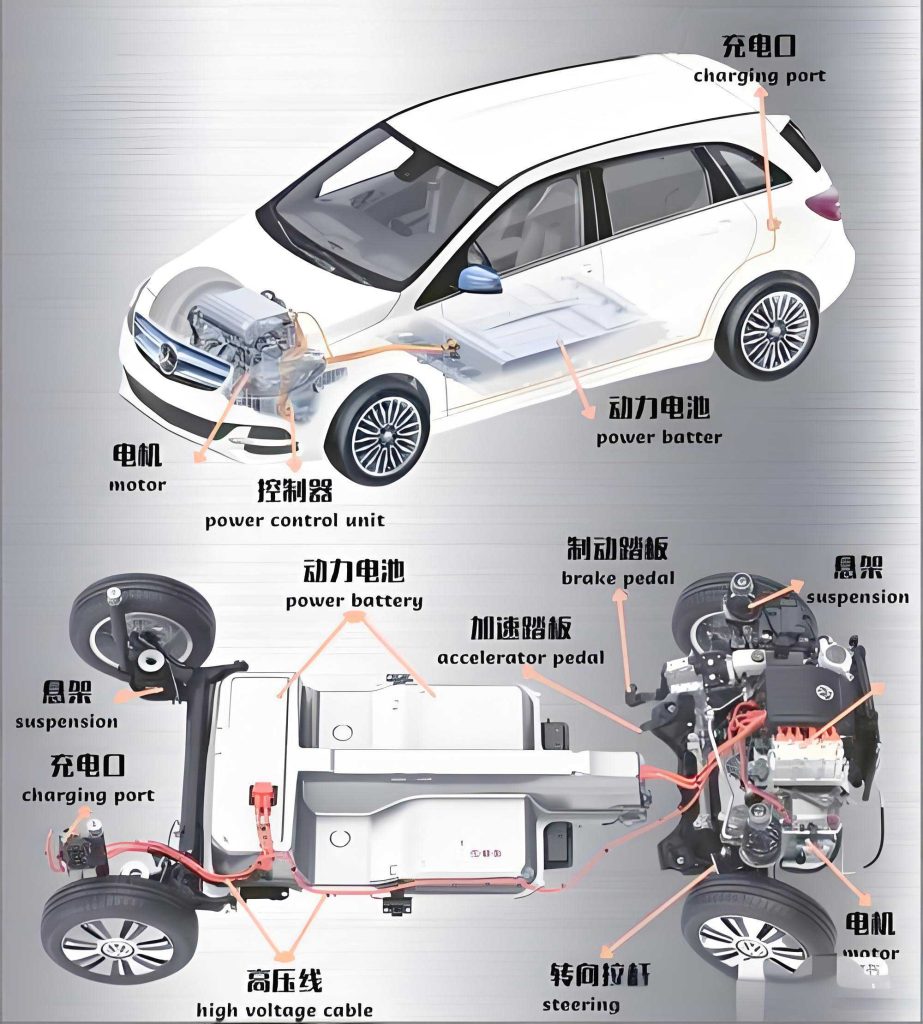
The transition towards sustainable transportation is undeniable, and battery electric cars are at its forefront. My experience indicates that the evolution of charging stations has shifted from mere quantitative deployment to qualitative optimization. In this context, I will explore how different charging station types cater to varied needs, how construction models can be streamlined, and how operational efficiency can be maximized. The widespread adoption of battery electric cars hinges on a reliable, accessible, and user-friendly charging network. Therefore, this study is not merely theoretical but rooted in practical observations and industry trends, aiming to bridge gaps between planning and execution.
Type Classification and Functional Positioning of Charging Stations for Battery Electric Cars
From my analysis, charging stations for battery electric cars can be categorized based on spatial layout, service entities, and functional demands. Each category has distinct characteristics that influence design and operation.
Spatial Layout Classification: Based on service radius and usage frequency, I classify charging stations into four primary types. The choice of location and technology is crucial for meeting the needs of battery electric car users.
| Type | Typical Location | Charging Power | Key Features | Primary Challenges |
|---|---|---|---|---|
| Urban Fast Charging Station | Commercial districts, office areas | 120–250 kW DC | High turnover, large traffic volume | High land cost, grid connection difficulties |
| Community Slow Charging Station | Residential areas | 7–11 kW AC | Stable usage, overnight charging | Property rights coordination, insufficient grid capacity |
| Highway Service Area Station | Expressway service zones | ≥250 kW Ultra-fast DC | Serves long-distance travel, peak load demands | Requires energy storage support, high construction complexity |
| Dedicated Depot Station | Bus depots, logistics parks | 40–100 kW Customized DC | Closed management, batch charging | Grid adaptation, scheduling matching |
For instance, urban fast charging stations are essential for battery electric cars in dense cities, where time is a premium. In contrast, community slow charging stations support the daily needs of battery electric car owners at home, promoting convenience. The functional requirements vary significantly; thus, a one-size-fits-all approach is ineffective. I have observed that highway stations must integrate energy storage to manage intermittent high loads from battery electric cars, while dedicated depots require tailored scheduling algorithms.
Service Entity Classification: Investment sources define three main models. Understanding these helps in assessing the sustainability and accessibility of charging for battery electric cars.
| Model | Investor | Service Scope | Pricing Mechanism | Operational Focus |
|---|---|---|---|---|
| Public Service Model | Government or state-owned platforms | Open to all battery electric cars | Basic fixed pricing | Public welfare, broad coverage |
| Enterprise Dedicated Model | Automakers or fleet operators | Brand users or internal battery electric cars | Often free or subsidized | High standards, brand loyalty |
| Marketized Operation Model | Private enterprises or platforms | Mixed: public and dedicated battery electric cars | Dynamic pricing, subscription plans | Profit-driven, technology-enabled |
In my work, I’ve seen that marketized operators often leverage platform technologies to serve a diverse fleet of battery electric cars, creating flexible business models. The functional needs analysis, as summarized in the diagram below, highlights how technical configuration, management systems, and user behavior intersect. For example, a battery electric car user at a highway station prioritizes speed and reliability, whereas at a community station, cost and availability are key. This necessitates differentiated design strategies.
Construction Modes and Optimization Pathways for Charging Stations
From my involvement in projects, I assert that the construction of charging stations for battery electric cars requires a multifaceted approach, balancing investment, planning, and technology.
Construction Entities and Investment Mechanisms: The participation of diverse entities—government, utilities, automakers, and private operators—creates a synergistic landscape. For battery electric car infrastructure, Public-Private Partnership (PPP) models are effective in sharing risks and rewards. I recommend exploring green bonds and Real Estate Investment Trusts (REITs) for financing large-scale projects, especially those integrating renewable energy. A revenue model for a charging station catering to battery electric cars can be expressed as:
$$ \text{Total Revenue} = R_{\text{charging}} + R_{\text{ancillary}} + R_{\text{grid services}} $$
where \( R_{\text{charging}} \) is from electricity fees for battery electric cars, \( R_{\text{ancillary}} \) includes advertising and data services, and \( R_{\text{grid services}} \) comes from V2G (Vehicle-to-Grid) participation. This diversification is crucial for profitability.
Site Selection and Grid Connection: Based on urban data analytics, I propose a demand-driven site selection model. For battery electric car adoption, stations must be accessible and grid-compatible. The optimization problem can be formulated as:
$$ \min_{x_i} \sum_{i=1}^{n} (C_{\text{land},i} + C_{\text{grid},i}) \cdot x_i \quad \text{subject to} \quad \sum_{i=1}^{n} d_{ij} x_i \geq D_j \ \forall j $$
where \( x_i \) is a binary variable for station location \( i \), \( C_{\text{land},i} \) and \( C_{\text{grid},i} \) are costs, \( d_{ij} \) is distance to demand point \( j \) (e.g., areas with high concentration of battery electric cars), and \( D_j \) is the demand. Grid connection challenges can be mitigated by integrating storage; the required battery capacity \( B \) can be estimated as:
$$ B = \frac{P_{\text{peak}} – P_{\text{grid limit}}}{\eta} \cdot t_{\text{peak}} $$
with \( P_{\text{peak}} \) as peak demand from battery electric cars, \( P_{\text{grid limit}} \) as grid capacity, \( \eta \) as efficiency, and \( t_{\text{peak}} \) as peak duration.
Equipment Selection and Standardization: For battery electric cars, choosing the right charger is paramount. I advocate for scenario-based selection, as shown in the table below.
| Scenario | Recommended Charger Type | Power Rating | Key Consideration for Battery Electric Cars |
|---|---|---|---|
| Urban Fast Charging | DC Fast Charger | 120–250 kW | High-power output to minimize charging time for battery electric cars |
| Community Charging | AC Slow Charger | 7–11 kW | Cost-effectiveness and compatibility with home battery electric car usage patterns |
| Highway Corridor | Ultra-fast DC Charger | ≥250 kW | Support for long-range battery electric cars, with thermal management |
| Fleet Depot | Customized DC Charger | 40–100 kW | Synchronized charging schedules for multiple battery electric cars |
Standardization is vital for interoperability. I urge adherence to international standards like IEC 61851 for battery electric car charging, coupled with third-party certification to ensure quality.
Multi-party Coordination and Regulatory Mechanisms: In my experience, streamlined approval processes are essential. A unified digital platform for permits can reduce delays. Regulatory oversight should involve real-time monitoring of stations serving battery electric cars, with Key Performance Indicators (KPIs) such as uptime and user satisfaction. A compliance score \( S \) can be computed as:
$$ S = w_1 \cdot \text{Uptime\%} + w_2 \cdot \text{Safety Score} + w_3 \cdot \text{User Rating} $$
where \( w_1, w_2, w_3 \) are weights, ensuring stations for battery electric cars meet minimum thresholds.
Operational Mechanisms and Management Modes for Charging Stations
Operating charging stations for battery electric cars efficiently demands intelligent systems and user-centric approaches. From my operational insights, I detail below the core components.
Operational Entities and Service Models: The landscape is dominated by three entity types, each with distinct strategies for serving battery electric cars. Marketized operators, in particular, employ dynamic pricing models that adjust based on demand from battery electric cars. For example, a time-of-use pricing function can be defined as:
$$ P(t) = P_{\text{base}} + \alpha \cdot \frac{L(t)}{L_{\text{avg}}} $$
where \( P(t) \) is the price at time \( t \), \( P_{\text{base}} \) is the base rate, \( \alpha \) is a scaling factor, and \( L(t) \) is the load from battery electric cars relative to average \( L_{\text{avg}} \). This incentivizes off-peak charging for battery electric cars, optimizing grid usage.
Intelligent Dispatch and Maintenance Systems: To manage large networks of chargers for battery electric cars, I implement cloud-based platforms with edge computing. A dispatch algorithm allocates power among multiple battery electric cars to maximize throughput. The optimization for a station with \( n \) chargers can be expressed as:
$$ \max \sum_{i=1}^{n} U_i(x_i) \quad \text{subject to} \quad \sum_{i=1}^{n} x_i \leq P_{\text{total}}, \ x_i^{\min} \leq x_i \leq x_i^{\max} $$
where \( U_i \) is the utility function for charging battery electric car \( i \), \( x_i \) is power allocated, and \( P_{\text{total}} \) is total station power. Predictive maintenance uses health scores \( H \) for each charger, derived from:
$$ H = 1 – \frac{\sum \text{failure incidents}}{\sum \text{operating hours}} \cdot e^{-\lambda t} $$
with \( \lambda \) as a decay constant. This proactive approach minimizes downtime for battery electric car users.
User Experience and Behavior Guidance: Enhancing the experience for battery electric car drivers is paramount. I focus on factors like wait time reduction and seamless payments. Behavior guidance leverages data analytics; for instance, a recommendation system suggests optimal charging times for battery electric cars based on historical patterns. The user satisfaction index \( I_{\text{sat}} \) can be modeled as:
$$ I_{\text{sat}} = \beta_0 + \beta_1 \cdot \text{Accessibility} + \beta_2 \cdot \text{Charging Speed} + \beta_3 \cdot \text{Price Fairness} $$
where \( \beta \) coefficients are derived from surveys of battery electric car owners. Platforms also introduce carbon credit systems, rewarding battery electric car users for green behavior, thus fostering loyalty.
Cost-Benefit Analysis: Sustainability requires meticulous financial planning. The cost structure for a station serving battery electric cars includes capital and operational expenses. A simplified profit model over time \( T \) is:
$$ \text{Net Profit} = \int_0^T \left( \sum_{j} R_j(t) – C_{\text{grid}}(t) – C_{\text{maintenance}}(t) – C_{\text{capital}}(t) \right) dt $$
where \( R_j(t) \) are revenue streams from battery electric car charging and ancillary services. To improve economics, I advocate for leveraging government subsidies for battery electric car infrastructure and exploring V2G revenues. The table below summarizes key cost and revenue drivers.
| Cost Component | Description | Typical Percentage of Total |
|---|---|---|
| Capital Depreciation | Charger and infrastructure investment for battery electric cars | 30–40% |
| Electricity Cost | Power purchased for charging battery electric cars | 20–30% |
| Maintenance | Routine and repair costs for chargers | 10–15% |
| Land Lease | Rental fees for station sites | 15–25% |
| Platform & Labor | Management and technical support | 5–10% |
| Revenue Stream | Source | Potential Contribution |
|---|---|---|
| Charging Fees | Direct payment from battery electric car users | 60–80% |
| Ancillary Services | Advertising, data monetization | 10–20% |
| Grid Services | V2G, demand response for battery electric car fleets | 5–15% |
| Subsidies & Incentives | Government grants for promoting battery electric cars | 5–10% |
By optimizing these factors, stations can achieve profitability while supporting the growth of battery electric cars.
Conclusion and Future Perspectives
In conclusion, my comprehensive analysis underscores that charging stations are indispensable for the widespread adoption of battery electric cars. Through detailed classification, optimized construction modes, and intelligent operational mechanisms, we can build a resilient and efficient charging network. The integration of formulas and tables in this article illustrates the technical and economic nuances involved. Moving forward, I emphasize the need for continuous innovation in fast-charging technologies, enhanced grid integration, and user-centric services to cater to the evolving demands of battery electric car owners. The journey towards sustainable transportation relies on collaborative efforts among governments, industries, and researchers to refine charging infrastructure, ensuring that battery electric cars become the norm rather than the exception. This study, from my perspective, provides a foundational framework for advancing this critical component of the electric mobility ecosystem.