
From my perspective as an observer of the energy storage industry, the transition away from traditional lithium-ion batteries is accelerating due to well-known limitations such as high costs, poor low-temperature performance, and safety risks like fire or explosion. In this context, two promising alternatives have emerged: sodium-ion batteries, which serve as a cost-effective substitute, and solid-state batteries, which represent a significant upgrade. The central question I explore here is which technology will achieve widespread industrialization sooner. This analysis delves into the technical foundations, comparative advantages, challenges, and projected timelines for both, enriched with quantitative summaries through tables and formulas to clarify key points.
Let me begin with sodium-ion batteries. These devices operate on a principle similar to lithium-ion batteries, where ions shuttle between the cathode and anode during charge and discharge cycles. The fundamental shift is the use of sodium ions instead of lithium ions. Sodium is abundantly available in nature, constituting about 2.6% of the Earth’s crust, compared to lithium’s mere 0.006%, leading to dramatically lower raw material costs. A simplified representation of the cell reaction can be expressed as:
$$ \text{Na}^+ + e^- + \text{Cathode Material} \rightleftharpoons \text{Discharged/Charged States} $$
In terms of performance, sodium-ion batteries offer distinct benefits. Their electrolytes, often using sodium salts like NaPF₆, exhibit higher ionic conductivity—approximately 20% greater than typical lithium electrolytes—which enhances power delivery and efficiency. Safety is improved because sodium ions are less reactive than lithium ions, reducing risks of thermal runaway. However, the energy density remains a constraint. Current prototypes achieve around 135-160 Wh/kg, whereas advanced lithium-ion batteries exceed 250 Wh/kg. This trade-off is captured in the following comparison table:
| Parameter | Lithium-ion Battery | Sodium-ion Battery |
|---|---|---|
| Energy Density (Wh/kg) | 250-300 | 135-160 |
| Raw Material Cost (Indexed) | 100 | 40-60 |
| Low-Temperature Performance | Poor below -20°C | Moderate improvement |
| Fast-Charging Capability | Good | Excellent due to high conductivity |
| Safety Profile | Risk of fire | Enhanced stability |
| Projected Industrialization | Mature | 2023-2026 scale-up |
The industrialization timeline for sodium-ion batteries appears imminent. I estimate that 2023 marks the beginning of serious commercialization efforts, with pilot production lines already established. By 2026, these batteries could alleviate market pressures by offering a low-cost alternative for applications like urban electric vehicles with ranges under 500 km, energy storage systems, and backup power. The driving forces include not only material cost advantages but also policy support promoting rapid adoption. For instance, government initiatives are encouraging deployment in grid storage and telecommunications, accelerating the technology’s maturity.
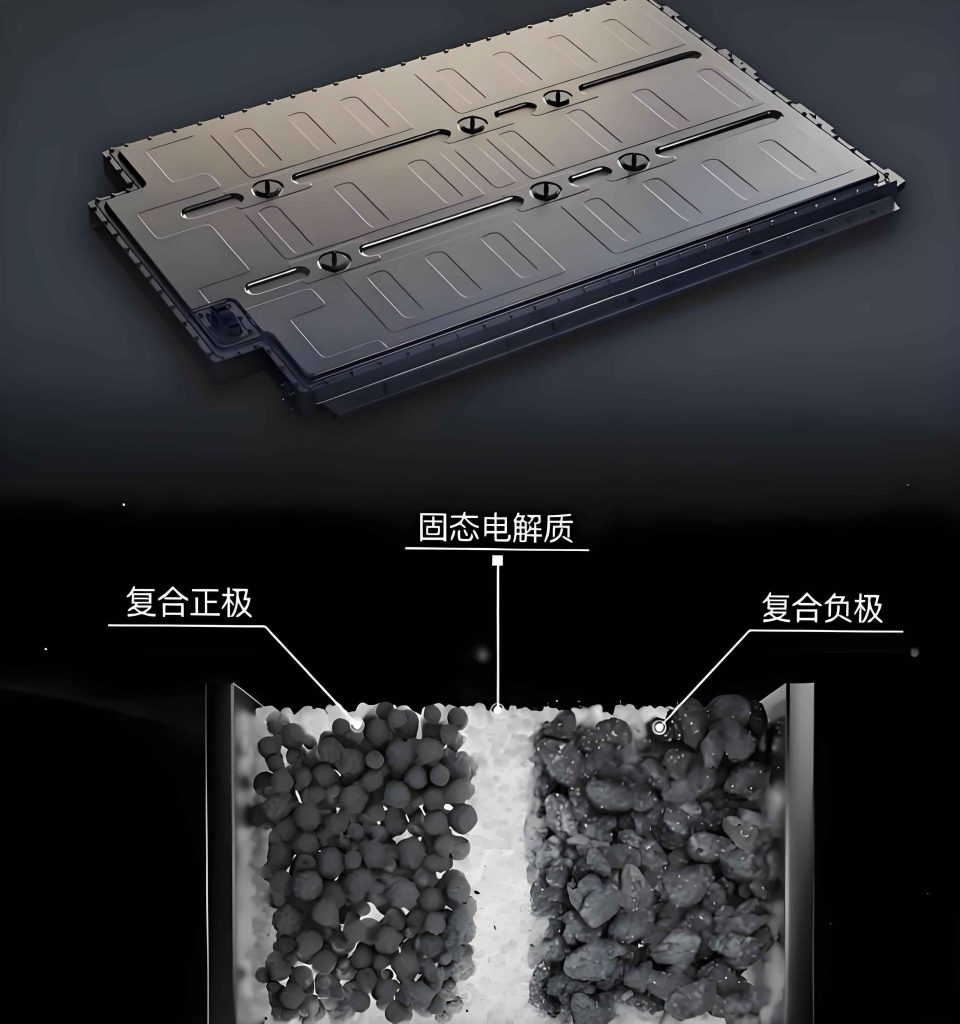
Now, turning to solid-state batteries, which represent a more revolutionary leap. In a solid-state battery, the liquid electrolyte found in conventional lithium-ion batteries is replaced with a solid electrolyte. This eliminates flammable organic solvents, leading to superior safety and enabling the use of high-energy-density electrodes like lithium metal. The general structure can be described as:
$$ \text{Anode (e.g., Li metal)} \, | \, \text{Solid Electrolyte} \, | \, \text{Cathode (e.g., NMC)} $$
The solid electrolyte must have high ionic conductivity for lithium ions, typically expressed as:
$$ \sigma_{\text{Li}^+} = \frac{n q \mu}{A} $$
where \( \sigma_{\text{Li}^+} \) is the ionic conductivity, \( n \) is the charge carrier density, \( q \) is the charge, \( \mu \) is the mobility, and \( A \) is the cross-sectional area. Advanced solid electrolytes, such as sulfides or oxides, aim for conductivities exceeding \( 10^{-3} \, \text{S/cm} \) at room temperature. The benefits are profound: energy densities can potentially surpass 500 Wh/kg at the cell level, weights and volumes can be reduced significantly, and safety reaches new heights since solid materials resist leakage and combustion. To illustrate, consider this table contrasting solid-state batteries with incumbent technologies:
| Aspect | Lithium-ion (Liquid) | Solid-state Battery |
|---|---|---|
| Electrolyte State | Liquid or gel | Solid (ceramic/polymer) |
| Cell Energy Density (Wh/kg) | 250-300 | Target: 400-500+ |
| Safety | Moderate (fire risk) | High (non-flammable) |
| Operating Temperature Range | Limited | Broader potential |
| Cycle Life (Projected) | 1000-2000 cycles | Potential for >5000 cycles |
| Cost Status | ~$100/kWh (pack) | Currently high, but declining |
| Industrialization Forecast | Mature | 2030 for early adoption |
In my view, the solid-state battery is gaining momentum but faces more complex hurdles. Manufacturing scalability is a key challenge, as producing thin, defect-free solid electrolyte layers requires precision techniques. Cost reduction is critical; current estimates suggest solid-state batteries may cost 2-3 times more than lithium-ion versions, but innovations in material synthesis could cut this within five years. The global capacity for solid-state batteries is projected to reach about 40 GWh by 2023, with cell-level energy density targets of 500 Wh/kg. Leading battery makers and startups have outlined clear roadmaps for commercialization within the next decade, focusing initially on niche applications like premium electric vehicles.
I find the competition between these technologies fascinating. Sodium-ion batteries, with their lower technological barrier and cost edge, are likely to industrialize faster—possibly within the next 2-3 years for mass adoption in cost-sensitive segments. In contrast, the solid-state battery, despite its superior performance, requires more R&D to overcome material and production challenges, pushing its full-scale industrialization toward 2030. However, the solid-state battery’s potential to revolutionize energy storage cannot be overstated; it promises to redefine safety and energy density benchmarks. To quantify the race, consider a combined timeline table:
| Timeframe | Sodium-ion Battery Milestones | Solid-state Battery Milestones |
|---|---|---|
| 2023-2025 | Pilot production, entry into EVs (<400 km range), grid storage deployment | Prototype validation, small-scale manufacturing, automotive partnerships |
| 2026-2030 | Cost parity with lithium-ion, expansion to 500+ km range EVs | First commercial vehicles, cost breakthroughs, capacity scaling to ~100 GWh |
| 2030-2035 | Dominance in stationary storage, potential market share >20% in some sectors | Widespread adoption in premium EVs, next-gen variants (e.g., lithium-sulfur solid-state) |
| Beyond 2035 | Maturation as a mainstream option for diverse applications | Potential to capture >50% of high-performance battery market |
From a technical standpoint, the evolution of solid-state batteries involves continuous improvement in electrolyte materials. For example, the conductivity of a solid electrolyte can be modeled with the Arrhenius equation:
$$ \sigma = \sigma_0 \exp\left(-\frac{E_a}{kT}\right) $$
where \( \sigma_0 \) is the pre-exponential factor, \( E_a \) is the activation energy, \( k \) is Boltzmann’s constant, and \( T \) is temperature. Reducing \( E_a \) through material design is crucial for enhancing low-temperature performance. Meanwhile, for sodium-ion batteries, the capacity retention over cycles can be expressed as:
$$ C_{\text{retention}} = C_0 \times (1 – \alpha)^n $$
where \( C_0 \) is initial capacity, \( \alpha \) is the degradation rate per cycle, and \( n \) is the cycle number. Optimizing electrode materials to minimize \( \alpha \) is key to longevity.
In conclusion, I believe both technologies will carve out significant roles. Sodium-ion batteries, with their rapid industrialization path, offer a near-term solution to diversify the battery supply chain and reduce costs. The solid-state battery, while further out, represents the future of high-performance, safe energy storage. Its development is accelerating, driven by intense R&D and strategic investments. Ultimately, the energy storage landscape will likely become more pluralistic, with sodium-ion batteries addressing cost and resource concerns, and solid-state batteries unlocking new frontiers in electric mobility and beyond. The race is not just about which comes first, but how each complements the other in building a sustainable energy ecosystem.