
As a key player in the global new energy sector, we have witnessed the rapid evolution of battery technologies, with solid-state batteries emerging as a transformative innovation. Solid-state batteries are widely regarded as the next-generation battery technology due to their potential for higher safety, greater energy density, and longer cycle life compared to conventional liquid lithium-ion batteries. In this article, we will explore the current landscape, challenges, and future directions of solid-state battery development, with a focus on Jiangsu Province, China. We will delve into technical aspects, market trends, and strategic recommendations, incorporating tables and formulas to summarize key points. Throughout this discussion, the term ‘solid-state battery’ will be emphasized repeatedly to underscore its significance.
The transition to solid-state batteries is driven by the limitations of current liquid electrolytes, which pose safety risks such as thermal runaway and have reached energy density ceilings around 300 Wh/kg. Solid-state batteries, by replacing liquid electrolytes with solid materials, promise to overcome these hurdles. The energy density of a solid-state battery can be expressed as:
$$E_{ss} = \frac{Q \cdot V}{m}$$
where \(E_{ss}\) is the energy density in Wh/kg, \(Q\) is the charge capacity in Ah, \(V\) is the voltage in V, and \(m\) is the mass in kg. For solid-state batteries, theoretical values exceed 400 Wh/kg, enabling applications in electric vehicles, low-altitude economy, humanoid robots, and energy storage systems. The solid electrolyte is central to this advancement, with ideal properties including high ionic conductivity (\(\sigma_i > 10^{-3}\) S/cm), chemical stability, and mechanical strength. Common solid electrolyte materials include polymers, oxides, sulfides, and halides, each with trade-offs. For instance, sulfide-based electrolytes offer high conductivity but require stringent handling due to air sensitivity.
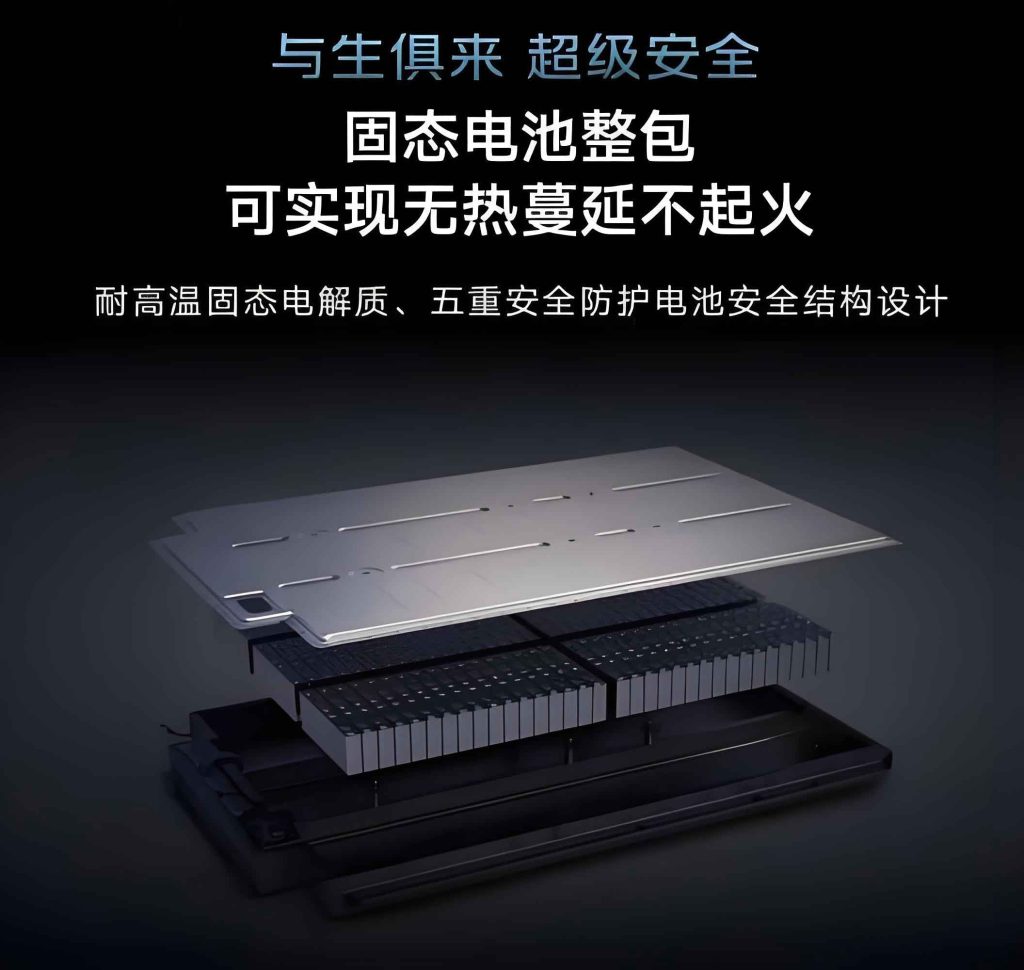
Globally, the solid-state battery industry is accelerating, with semi-solid batteries already entering commercial use as a transitional step. We observe that full solid-state batteries remain in the R&D and pilot stages, with mass production anticipated around 2027-2030. The following table summarizes the international and domestic status of solid-state battery development:
| Region | Key Players | Technology Focus | Current Status | Projected Timeline for Mass Production |
|---|---|---|---|---|
| United States | SolidPower, QuantumScape, SES | Full solid-state batteries, sulfide and oxide routes | Pilot testing and partnerships with automakers | 2027-2030 |
| Europe | BMW, Volkswagen, partnerships with U.S. startups | Investment in solid-state battery startups, hybrid approaches | Collaborative R&D, early prototype integration | 2028-2032 |
| Japan | Toyota, Honda, Panasonic | Sulfide-based solid-state batteries, extensive patent portfolios | Advanced R&D, aiming for commercialization by 2027 | 2027-2030 |
| South Korea | Samsung SDI, LG Energy Solution, SK Innovation | Full solid-state batteries, delivery of test samples | Testing with EV manufacturers, strong technical capabilities | 2026-2029 |
| China | Qingtao Energy, Weilan New Energy, CATL, BYD | Semi-solid batteries (300-380 Wh/kg), sulfide-based full solid-state | Semi-solid batteries in量产 vehicles, full solid-state R&D同步 | Semi-solid: now; full solid-state: 2027-2030 |
In China, the solid-state battery industry has over 250 companies across the value chain. Semi-solid batteries, with energy densities of 300-380 Wh/kg, have been deployed in vehicles like the Nio ET7 and IM L6. Full solid-state batteries are progressing in parallel, with companies like CATL and BYD targeting示范 applications by 2027. The dominant technology route in China involves sulfide-based composite electrolytes, which balance performance and practicality. The ionic conductivity of these composites can be modeled as:
$$\sigma_{composite} = \phi_{org} \sigma_{org} + \phi_{inorg} \sigma_{inorg}$$
where \(\phi\) represents volume fractions and \(\sigma\) the conductivity of organic and inorganic components.
Turning to Jiangsu Province, we find a robust foundation for solid-state battery development, leveraging its leadership in the动力 battery sector. Jiangsu ranks among the top regions in China for battery industry scale, supply chain completeness, and innovation. The province has actively pursued前瞻布局 in solid-state batteries and key materials, attracting numerous enterprises and startups. We estimate that over 30 companies in Jiangsu are directly involved in solid-state battery-related activities, covering cell manufacturing, electrolyte production, electrode materials, and equipment. The following table details the industrial landscape in Jiangsu:
| Category | Companies/Projects | Location | Key Activities | Current Status |
|---|---|---|---|---|
| Cell Manufacturers | CALB,蜂巢 Energy, Qingtao Energy, Heyuan Lithium Innovation | Changzhou, Suzhou, Nanjing | R&D and production of semi-solid and full solid-state batteries | Semi-solid batteries in pilot or量产; full solid-state in R&D |
| Electrolyte Suppliers | Langu New Energy, Zhongke Guneng,蓝固新能源 | Changzhou, Wuxi | Development of oxide and sulfide solid electrolytes | Scale-up to吨级 production; oxide capacity at 1500 t/year |
| Electrode Material Providers | Dangsheng Technology,贝特瑞, Tianmu Xiandao | Nanjing, Suzhou | Adaptation of high-nickel cathodes and silicon-carbon anodes for solid-state batteries | R&D and small-scale supply |
| Equipment Makers | Wuxi Lead Intelligent | Wuxi | Supply of full solid-state battery production lines | Global launch of integrated solutions |
The产业化进程 in Jiangsu is领先 nationally. Semi-solid batteries are nearing mass production, with companies like Qingtao Energy operating a 0.7 GWh facility in Kunshan and planning a 10 GWh expansion. Heyuan Lithium Innovation has established pilot lines in Suzhou and is building a 10 GWh base in Huaian. Full solid-state batteries are advancing rapidly: CALB has unveiled a 430 Wh/kg “boundless” solid-state battery and plans to start pilot production in 2025, with vehicle integration by 2027.蜂巢 Energy has developed sulfide-based solid-state电池 samples. The cost of solid-state batteries remains a critical factor, currently estimated at over 2 CNY/Wh, compared to about 0.6 CNY/Wh for liquid lithium-ion batteries. We can express the cost challenge as:
$$C_{ss} = C_{materials} + C_{processing} + C_{R&D}$$
where \(C_{ss}\) is the total cost, driven by expensive materials like sulfide precursors (e.g., lithium sulfide at ~2000 CNY/kg) and complex processing.
Technological innovation in Jiangsu is突出, with a focus on composite electrolytes. For example, Qingtao Energy holds over 1,300 patents and has launched a 368 Wh/kg solid-state battery. CALB and蜂巢 Energy have released products with energy densities of 350-430 Wh/kg. The ionic conductivity of these electrolytes often exceeds \(10^{-4}\) S/cm, crucial for performance. The Arrhenius equation describes the temperature dependence:
$$\sigma = \sigma_0 \exp\left(-\frac{E_a}{kT}\right)$$
where \(E_a\) is activation energy, \(k\) is Boltzmann’s constant, and \(T\) is temperature. Reducing \(E_a\) is key for low-temperature operation. Moreover, Jiangsu’s industrial集聚 is evident in cities like Changzhou and Suzhou, which rank among China’s top ten for solid-state battery competitiveness, according to a 2024 report by EVTank. This clustering fosters collaboration and supply chain efficiency.
However, the solid-state battery industry faces several瓶颈问题 that we must address. These span technical, manufacturing, and market barriers. We categorize them below:
| Category | Specific Issues | Impact on Solid-State Battery Adoption |
|---|---|---|
| Technical Uncertainties | Multiple electrolyte routes (polymer, oxide, sulfide, halide), interface stability, material compatibility | Delays in identifying optimal paths; solid-solid interface impedance limits performance |
| Material Science Hurdles | High-nickel cathode safety, silicon anode expansion, lithium dendrite growth, electrolyte stability | Reduced cycle life and safety; requires new material designs |
| Manufacturing Complexities | High-pressure processing (up to hundreds of MPa), dry electrode techniques, environmental controls (e.g., for sulfide handling) | Low yield rates and high capital expenditure; ~2/3 of liquid battery equipment may become obsolete |
| Cost and Supply Chain | High material costs, immature supply chains for solid electrolytes and specialized equipment | Prolongs time to cost parity with liquid batteries |
| Market Application Gaps | Limited demand from emerging sectors (e.g., eVTOL, humanoid robots), competition from improved liquid batteries | Slow scaling and validation in real-world scenarios |
From a technical perspective, the interface between electrode and electrolyte is a major challenge. The interfacial resistance \(R_{interface}\) can be modeled as:
$$R_{interface} = \frac{\delta}{\sigma_{contact}}$$
where \(\delta\) is the interfacial thickness and \(\sigma_{contact}\) is the contact conductivity. Poor contact increases impedance, reducing power density. Additionally, manufacturing processes like干法 electrode fabrication require precision alignment, with tolerances often below 10 μm. The production yield \(Y\) can be expressed as:
$$Y = \prod_{i=1}^{n} (1 – p_i)$$
where \(p_i\) is the defect probability at each step, which is higher for solid-state batteries due to complex steps.
In Jiangsu, we recognize that policy support has been lacking at the provincial level. There is no dedicated strategy for solid-state batteries, hindering coordinated R&D and market promotion. Furthermore, industry-academia linkages need strengthening to accelerate innovation. To overcome these hurdles, we propose the following对策建议, structured into key action areas:
| Recommendation Area | Specific Actions | Expected Outcomes |
|---|---|---|
| Strategic and Policy Enhancement | Develop a provincial专项 plan for solid-state batteries, integrate into the “15th Five-Year” plan, provide funding, tax incentives, and talent support | Clear direction, increased investment confidence, and faster industrialization |
| Technological Breakthroughs | Establish R&D platforms, foster产学研 alliances, focus on interface engineering, composite electrolytes, and干法 processes; set industry standards | Improved ionic conductivity (>10^{-3} S/cm), longer cycle life (>1000 cycles), and lower costs |
| Enterprise Cultivation | Support leading firms like CALB and蜂巢 Energy in scaling up, attract startups, build “chain master” enterprises, and nurture独角兽 companies | Enhanced competitiveness, complete supply chains, and global market presence |
| Market Application Exploration | Promote pilot projects in EVs, drones, energy storage, and robotics; organize demonstration programs to drive down costs through volume | Faster cost reduction via learning curves: \(C(n) = C_0 \cdot n^{-b}\), where \(b\) is the learning rate |
| Ecosystem Development | Ensure resource allocation (land, energy), facilitate international collaboration, create talent databases, and support testing platforms | Sustainable growth, knowledge exchange, and robust industry clusters |
We believe that implementing these recommendations will position Jiangsu as a leader in the solid-state battery revolution. For instance, in technological breakthroughs, targeting a composite electrolyte with conductivity of \(5 \times 10^{-3}\) S/cm at room temperature could enable energy densities above 500 Wh/kg. The cost reduction trajectory can be projected using experience curve models:
$$C_{ss}(t) = C_{ss}(0) \cdot e^{-\alpha t}$$
where \(\alpha\) is the improvement rate, estimated at 10-15% per year with sufficient investment.
In conclusion, the solid-state battery represents a paradigm shift in energy storage, with immense potential to transform transportation and beyond. Jiangsu Province, with its strong industrial base and innovative spirit, is well-poised to capitalize on this opportunity. However, success requires navigating technical complexities, fostering collaboration, and embracing strategic foresight. We urge stakeholders to act decisively, ensuring that solid-state batteries evolve from promise to reality, solidifying Jiangsu’s role in the global energy landscape. The journey ahead is challenging, but with concerted efforts, solid-state batteries can become a cornerstone of a sustainable future.
To further illustrate the performance metrics, consider the Ragone plot for solid-state batteries compared to conventional ones. The power density \(P\) and energy density \(E\) relate as:
$$P = \frac{V^2}{R_{internal}}$$
where \(R_{internal}\) includes bulk and interfacial resistances. For solid-state batteries, reducing \(R_{internal}\) is critical for high-power applications. Additionally, cycle life degradation often follows:
$$Q_{loss} = A \cdot \exp\left(-\frac{E_a}{kT}\right) \cdot t^n$$
where \(Q_{loss}\) is capacity loss, \(A\) is a constant, and \(n\) is the degradation exponent. Solid-state batteries aim for \(n < 0.5\) to ensure longevity. As we advance, continuous iteration on materials and processes will be essential. The solid-state battery industry is not just about incremental improvement but a leap forward, and we are committed to driving this transformation from the forefront in Jiangsu.