
The evolution of energy storage stands as one of the defining technological quests of our era. From my observations and analysis, the transition from liquid-electrolyte lithium-ion batteries to solid-state battery technology represents not merely an incremental improvement, but a fundamental paradigm shift. The pursuit of a solid-state battery is reshaping global R&D priorities, supply chain strategies, and the very future of electric mobility and grid storage. In this detailed exploration, I will delve into the scientific principles, material challenges, global competitive landscape, and future projections for this transformative technology, utilizing tables and formulas to crystallize the complex concepts at play.
At its core, a solid-state battery replaces the flammable organic liquid electrolyte found in conventional lithium-ion cells with a solid ion-conducting medium. This fundamental change in architecture—comprising a solid cathode, a solid electrolyte, and a solid anode—unlocks a cascade of potential advantages. The most prominent is enhanced safety, as the removal of volatile liquids significantly mitigates fire and explosion risks. Furthermore, the use of a solid electrolyte enables the integration of advanced, high-capacity electrode materials that are incompatible with liquid systems, most notably lithium metal anodes. This combination is the key to unlocking drastically higher energy densities.
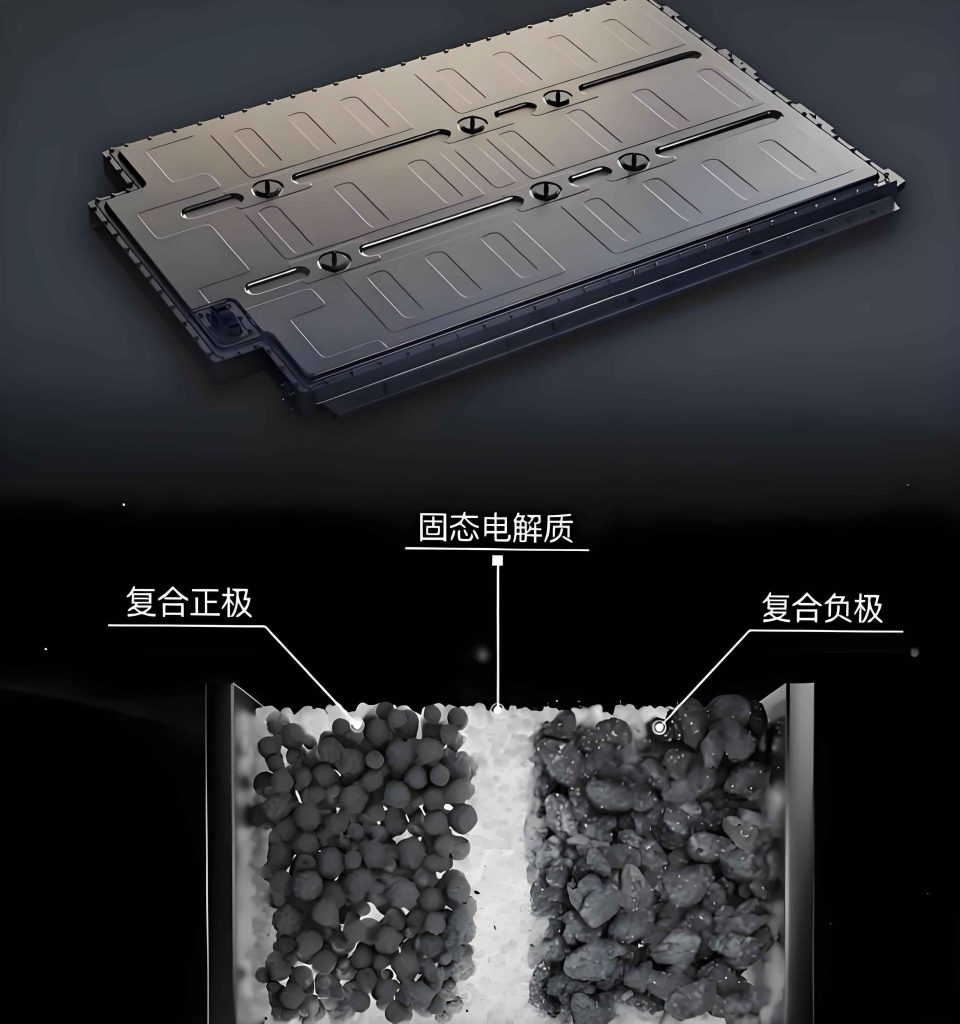
The theoretical promise of the solid-state battery is captured in several key performance metrics. The energy density, often the most cited figure, can be expressed as:
$$ E = \frac{C_{cathode} \times V_{cell}}{m_{cell}} $$
where \( E \) is the gravimetric energy density (Wh/kg), \( C_{cathode} \) is the capacity of the cathode material, \( V_{cell} \) is the average cell voltage, and \( m_{cell} \) is the total cell mass. By enabling lithium metal anodes (theoretical capacity ~3,860 mAh/g vs. graphite’s 372 mAh/g) and high-voltage cathodes, the solid-state battery aims to push \( E \) well beyond 400 Wh/kg, with a long-term roadmaps targeting 500+ Wh/kg.
The heart of any solid-state battery is the solid electrolyte. Its performance is primarily governed by its ionic conductivity (\( \sigma_{Li+} \)) and its electrochemical stability window. The ionic conductivity follows an Arrhenius-type relationship:
$$ \sigma = \frac{A}{T} \exp\left(-\frac{E_a}{k_B T}\right) $$
where \( A \) is a pre-exponential factor, \( E_a \) is the activation energy for ion migration, \( k_B \) is Boltzmann’s constant, and \( T \) is the temperature. The quest is for materials with high \( \sigma_{Li+} \) (ideally >1 mS/cm at room temperature) and low \( E_a \). The main categories of solid electrolytes are summarized below:
| Electrolyte Class | Example Materials | Ionic Conductivity (25°C) | Key Advantages | Major Challenges |
|---|---|---|---|---|
| Oxides | Garnets (e.g., LLZO), Perovskites (e.g., LLTO), NASICON-types | 0.1 – 1 mS/cm | High stability vs. Li metal, good oxidative stability. | Brittle, high interfacial resistance, difficult manufacturing. |
| Sulfides | LGPS-type, argyrodites (e.g., Li₆PS₅Cl) | 1 – 25 mS/cm | Exceptional ionic conductivity, ductile, good processability. | Sensitive to moisture (release H₂S), narrow electrochemical window. |
| Polymers | PEO with Li salts | 0.01 – 0.1 mS/cm (60-80°C) | Flexible, low-cost processing, good interfacial contact. | Low conductivity at RT, poor oxidative stability. |
| Halides | Li₃YCl₆, Li₃InCl₆ | 0.5 – 3 mS/cm | Good oxidative stability, compatible with high-voltage cathodes. | Moisture sensitivity, cost of raw materials. |
Beyond the electrolyte, the choice of electrode materials defines the ceiling of a solid-state battery‘s performance. For the cathode, the shift is towards high-nickel layered oxides (NMC, NCA), lithium-rich layered oxides, or even sulfur, all of which promise higher capacity and voltage. The anode frontier is dominated by lithium metal, but silicon-based composites are also a viable intermediate step. The challenge is formulating these electrodes as composite structures that maintain intimate ionic and electronic contact throughout charge-discharge cycles. The effective conductivity of such a composite cathode can be modeled as:
$$ \sigma_{eff} = \phi_{active} \cdot \sigma_{active} + \phi_{electrolyte} \cdot \sigma_{electrolyte} + \phi_{carbon} \cdot \sigma_{carbon} $$
where \( \phi \) and \( \sigma \) represent the volume fraction and conductivity of each component (active material, solid electrolyte, conductive carbon), respectively. Optimizing this triad is a critical materials engineering task.
However, the path to commercialization is littered with formidable “interface problems.” The rigid solid-solid contacts in a solid-state battery create high interfacial resistance. Worse, during cycling, volume changes in the electrodes and the propagation of lithium dendrites can mechanically degrade these interfaces, leading to rapid capacity fade. The growth of lithium dendrites through a solid electrolyte, while more difficult than through a liquid, is not impossible and remains a critical safety research topic. The pressure \( P \) required to maintain contact between a deforming lithium anode and a rigid solid electrolyte can be substantial, influencing cell design:
$$ P \propto \frac{\Delta V \cdot E_{electrolyte}}{t_{electrolyte}} $$
where \( \Delta V \) is the volume change of the anode, \( E_{electrolyte} \) is the Young’s modulus of the electrolyte, and \( t_{electrolyte} \) is its thickness.
These scientific challenges translate directly into manufacturing complexities. Fabricating thin, dense, and defect-free solid electrolyte layers at high speed and low cost is a primary hurdle. Processes like tape casting, screen printing, and physical vapor deposition are being adapted. The assembly of the multilayer structure—cathode composite | solid electrolyte separator | anode—often requires innovative techniques like lamination under heat and pressure. The scalability of these processes will ultimately determine the cost curve of the solid-state battery.
The global R&D landscape is intensely competitive, with different regions and consortia pursuing varied strategic approaches. Some focus on oxide-based electrolytes for their stability, investing in advanced sintering and thin-film technologies. Others champion sulfide electrolytes for their superior conductivity, developing entire supply chains and manufacturing ecosystems around moisture-controlled dry rooms. A third, pragmatic pathway involves hybrid or semi-solid designs, which incorporate some polymer or gel components to ease interfacial issues while retaining much of the safety benefit. This approach can be seen as a strategic stepping stone towards the ultimate all-solid-state battery.
The progression of the technology is often measured through generational benchmarks. The following table outlines a typical development roadmap:
| Generation | Anode | Cathode | Electrolyte Type | Target Energy Density | Primary Application Focus |
|---|---|---|---|---|---|
| 1st (Current) | Graphite/Si-C | NMC 622/811 | Polymer/Oxide Hybrid | 250-300 Wh/kg | Consumer Electronics, Drones |
| 2nd (Near-term) | Lithium Metal (Protected) | High-Ni NMC, NCA | Sulfide, Halide, Composite | 350-450 Wh/kg | Electric Aviation, Premium EVs |
| 3rd (Long-term) | Lithium Metal | Lithium-rich, Sulfur | Advanced Sulfide/Oxide | 500+ Wh/kg | Mass-Market EVs, Grid Storage |
The implications of a successful solid-state battery breakthrough are profound. For electric vehicles, it promises the elusive combination of long range (500+ miles), fast charging (potentially sub-15 minutes), and eliminated fire risk, which could decisively tip the market away from internal combustion engines. In aviation, the high specific energy is a prerequisite for the electrification of regional and commuter aircraft. For renewable energy grids, the inherent safety and potential longevity of a solid-state battery could lower the levelized cost of storage for multi-hour applications.
In my assessment, the final lap of this global race will not be won by a single laboratory breakthrough, but by the intricate integration of materials science, electrochemistry, mechanical engineering, and scalable manufacturing. The entity that first masters the science of stable interfaces *and* the economics of gigawatt-hour-scale production will command a significant advantage in the next energy era. The solid-state battery is more than a new component; it is the keystone for a safer, more energy-dense, and broadly electrified future. The collective effort pouring into its development today is a testament to its perceived role as a foundational technology for the 21st century.