
The continuous advancement of automotive electrification and intelligence has led to a significant increase in the density and complexity of onboard electronic devices. Consequently, the electromagnetic environment within a vehicle has become increasingly intricate, making Electromagnetic Compatibility (EMC) a critical design challenge. The electric drive system, comprising the motor and its power electronics, is a primary source of electromagnetic interference (EMI) within this environment. Its operational integrity and its impact on surrounding systems are paramount to vehicle safety and functionality. Therefore, a deep understanding and systematic mitigation of EMC issues in electric drive systems are of immense theoretical and practical importance. This article provides a comprehensive analysis of EMC problems in electric drive systems from a first-person engineering perspective, proposing a structured, frequency-domain-based approach and detailing corresponding mitigation strategies supported by analytical models and empirical data.
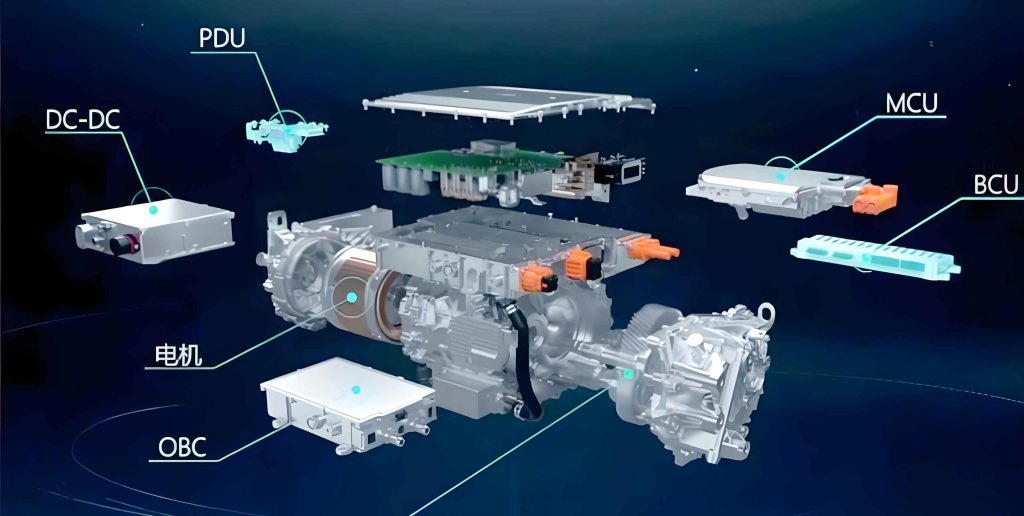
EMC for an electric drive system refers to its ability to function satisfactorily in its intended electromagnetic environment without introducing intolerable electromagnetic disturbances to other devices in that environment. It is a two-fold requirement: limiting electromagnetic emissions (Electromagnetic Interference, EMI) and maintaining sufficient immunity to external disturbances. The problem is inherently systemic, stemming from the fundamental operation of power electronic converters. High-frequency switching of Insulated-Gate Bipolar Transistors (IGBTs) or Silicon Carbide (SiC) MOSFETs, essential for efficient motor control via Pulse Width Modulation (PWM), generates rich harmonic spectra. These fast-changing voltages (dv/dt) and currents (di/dt) couple through parasitic capacitances and inductances, leading to conducted and radiated emissions. Key factors influencing EMC include:
- High-speed switching of power semiconductor devices.
- PWM carrier frequency and modulation strategy.
- Parasitic elements within the motor windings (e.g., winding capacitance) causing common-mode currents.
- Impedance mismatches and loop areas in cabling and busbars.
- Grounding strategy and common-impedance coupling.
A holistic solution requires interventions at the source (device and control), along the propagation path (filtering, shielding, layout), and at the victim receptor (immunity design).
To effectively analyze and address the wide-spectrum EMC challenges, it is practical to segment the frequency domain. This allows for targeted countermeasures, as the dominant coupling mechanisms and effective mitigation techniques vary with frequency. The following analysis divides the spectrum into three primary bands.
1. Frequency-Domain Analysis of EMC Issues
1.1 Low-Frequency Band (0.15 MHz – 30 MHz)
In this band, the primary concerns are conducted emissions along power cables and grounding systems. Disturbances manifest as harmonic currents and leakage currents, which can disrupt the function of low-frequency communication systems and sensors, and cause malfunctions in shared power networks. The dominant coupling mode is often differential-mode (DM) for lower harmonics and common-mode (CM) as frequency increases towards the upper end of this band.
The root causes in this band are closely tied to the fundamental PWM switching frequency (typically ranging from a few kHz to tens of kHz) and its lower-order harmonics. The non-sinusoidal current drawn by the inverter generates harmonic distortion reflected back to the DC link and battery. Furthermore, the high dv/dt at the motor terminals couples through the parasitic capacitance between the motor windings and the chassis ($$C_{wg}$$) to generate a common-mode ground current $$I_{cm}$$:
$$ I_{cm} \approx (C_{wg1} + C_{wg2} + C_{wg3}) \cdot \frac{dV_{cm}}{dt} $$
where $$V_{cm}$$ is the common-mode voltage, defined as $$V_{cm} = (V_{a} + V_{b} + V_{c}) / 3$$ for a three-phase system, and $$C_{wg1,2,3}$$ are the winding-to-ground capacitances for each phase.
Mitigation strategies for the low-frequency band focus on minimizing loop areas, providing low-impedance return paths, and filtering. A summary of key measures is provided in Table 1.
| Measure | Objective | Key Principle & Implementation |
|---|---|---|
| Optimized Grounding Design | Minimize ground loop impedance and area. | Implement a single-point or star grounding scheme for the electric drive system. Ensure thick, short grounding straps to minimize inductance $$L_g$$. The ground loop impedance $$Z_{loop} = R + j\omega L$$ must be kept low. |
| DM/CM Input Filtering | Attenuate conducted noise on DC input lines. | Install a multi-stage LC filter at the inverter input. DM choke ($$L_{dm}$$) with X-capacitors ($$C_x$$) attenuates line-to-line noise. CM choke ($$L_{cm}$$) with Y-capacitors ($$C_y$$) attenuates line-to-ground noise. The attenuation for a simple L-section is $$A_{dB} \approx 20 \log_{10}(1 + (\omega / \omega_c)^2)$$ where $$\omega_c = 1/\sqrt{LC}$$. |
| Shielded Cables | Contain magnetic and electric field radiation from power cables. | Use cables with a braided or foil shield, connected 360° to the chassis at both ends for high frequencies. For very low frequencies, single-end grounding may be used to prevent ground loops. |
| DC-Link Busbar Design | Minimize parasitic inductance in the DC link. | Use laminated busbars to closely couple the positive and negative rails, reducing loop area and parasitic inductance $$L_{parasitic}$$. This minimizes voltage spikes ($$V_{spike} = L_{parasitic} \cdot di/dt$$) during switching. |
| Control Strategy Adjustment | Reduce amplitude of lower-order harmonics. | Utilize optimized PWM patterns (e.g., Space Vector PWM with third harmonic injection) to improve voltage utilization and slightly shape the harmonic spectrum. However, the fundamental switching frequency remains the key determinant. |
1.2 Mid-Frequency Band (30 MHz – 300 MHz)
This is a critical transition band where disturbances can propagate both via conduction (dominant up to ~100 MHz) and radiation (becoming increasingly dominant above 100 MHz). Emissions in this band are primarily driven by the higher-order harmonics of the PWM switching frequency and the resonant frequencies of parasitic structures within the electric drive system. They can severely affect AM/FM radio, vehicle keyless entry systems, and other RF receivers.
The coupling mechanisms become more complex. Common-mode currents, excited by the high dv/dt, flow through the parasitic capacitance of the motor and cables to the chassis, creating large loop antennas. The cables themselves, if unshielded or poorly grounded, act as efficient radiating structures. The radiation efficiency increases with frequency (proportional to $$f^2$$). Furthermore, resonances in the mechanical structure (e.g., the motor housing) or the DC-link capacitor bank can amplify emissions at specific frequencies.
Mitigation requires a combination of filtering, shielding, and layout optimization, as detailed in Table 2.
| Measure | Objective | Key Principle & Implementation |
|---|---|---|
| Enhanced CM Filtering | Suppress common-mode currents before they reach radiating structures. | Use high-performance CM chokes with wideband impedance. Ferrite cores with high permeability at these frequencies are essential. The impedance of a ferrite bead/clamp is $$Z_{ferrite} = R(\omega) + j\omega L(\omega)$$, where the resistive part $$R(\omega)$$ provides broadband absorption. |
| Comprehensive Cable Shielding | Prevent cable radiation and reduce susceptibility. | Mandate the use of high-coverage (>=85%) braided shields for all high-power and sensitive signal cables. Ensure low-impedance, 360° circumferential bonding of the shield to the metal enclosure at cable entry points using EMI gland or conductive grommets. |
| Motor Terminal Filtering / dv/dt Filters | Reduce the source dv/dt exciting common-mode currents. | Install small RC snubber networks directly at the inverter output terminals or motor input terminals. This slows down the voltage edge seen by the cable and motor windings, reducing $$dV_{cm}/dt$$ and hence $$I_{cm}$$. The snubber time constant should be $$R_{snub} C_{snub} \approx 0.1 \cdot T_{rise}$$ of the IGBT. |
| Housing & Enclosure Shielding | Contain radiated fields from internal components. | Design inverter and controller enclosures as continuous, conductive Faraday cages. Pay meticulous attention to seams and apertures. Use EMI gaskets, conductive seals, and honeycomb air vents to maintain shielding integrity. The shielding effectiveness (SE) for an enclosure with apertures is dominated by the largest aperture dimension. |
| PWM Carrier Frequency Optimization | Avoid resonant frequencies and shift emissions away from sensitive bands. | While higher carrier frequencies improve motor acoustic noise and control bandwidth, they push fundamental switching harmonics into more sensitive mid-frequency bands. A strategic choice or even spread-spectrum techniques (frequency jitter) can be employed to disperse energy and reduce peak emissions. |
1.3 High-Frequency Band (Above 300 MHz)
Emissions in this UHF and microwave band are almost exclusively radiated. They are generated by very fast transients (nanosecond rise times) associated with diode reverse recovery in the inverter’s freewheeling path or resonances of small parasitic structures. These emissions can interfere with GPS, cellular communications (4G/5G), and tire pressure monitoring systems (TPMS).
The wavelengths at these frequencies are short (e.g., 1 m at 300 MHz, 10 cm at 3 GHz), meaning that even small PCB traces, connector pins, or unshielded wire segments can become efficient antennas. The dominant sources are often the control circuitry, gate drive loops, and sensor wires, rather than the main power stage itself. Coupling is through near-field radiation and slot antenna effects from small apertures in enclosures.
Mitigation requires a focus on containment at the component and enclosure level, as shown in Table 3.
| Measure | Objective | Key Principle & Implementation |
|---|---|---|
| Aperture Control & Seam Management | Maintain high shielding effectiveness at high frequencies. | The shielding effectiveness $$SE$$ of an enclosure is critically degraded by apertures. For a slot of length $$l$$, the cutoff frequency is $$f_c = c / (2l)$$. Above $$f_c$$, radiation increases significantly. Keep $$l << \lambda / 10$$ for the highest frequency of concern. Use multiple small holes instead of one large opening. |
| Localized Shielding & Absorbers | Suppress noise at the component level. | Apply small metal cans or shielded compartments over noisy ICs (e.g., switching regulators, gate drivers). Use RF absorbers (lossy magnetic or dielectric materials) inside enclosures or on cables to dampen resonances and convert EM energy to heat. The absorption loss follows the material’s complex permeability/permittivity. |
| PCB Layout for EMC | Minimize antenna creation on the control board. | Implement strict layout rules: minimize loop areas for high-speed signals; use ground planes; apply proper termination and impedance matching for transmission lines; isolate noisy and sensitive areas; use filter beads on all I/O lines. The radiated emission from a small loop is proportional to $$E \propto A \cdot f^2 \cdot I$$, where $$A$$ is the loop area. |
| Ferrite Clamps on All External Cables | Provide broadband absorption of common-mode currents on cables. | Install split-core ferrite clamps on all cables exiting the electric drive system enclosure, including power, communication (CAN, LIN), and sensor cables. Select ferrite material optimized for the UHF range. Multiple turns through the clamp increase impedance quadratically ($$Z \propto N^2$$). |
| Careful Component Selection | Choose devices with inherently lower high-frequency noise. | Select MOSFETs/IGBTs with soft recovery body diodes, gate drivers with controlled slew rates, and power supplies with low-noise architectures. Decoupling capacitor placement and selection (low-ESR/ESL) are crucial for suppressing high-frequency transients on the DC rails. |
2. Systematic Mitigation Strategies for Electric Drive System EMC
Effective EMC design for an electric drive system is a multi-layered, system engineering endeavor. The strategies must be integrated from the initial design phase and follow the fundamental EMI model: control the source, block the path, and protect the victim. The primary methodologies can be consolidated as follows:
| Strategy Layer | Focus Area | Core Techniques |
|---|---|---|
| Source Suppression | Reduce the amplitude or spectral content of generated noise. |
|
| Path Attenuation | Impede the propagation of noise to susceptible areas. |
|
| Receptor Hardening | Increase the immunity of sensitive circuits within and around the drive system. |
|
A critical and often underestimated aspect is the shielding effectiveness of the motor and inverter housings. The theoretical shielding effectiveness (SE) of a solid, continuous metal barrier is a sum of absorption loss (A), reflection loss (R), and multiple reflection corrections (B):
$$ SE = A_{dB} + R_{dB} + B_{dB} $$
For electric fields and plane waves, the absorption loss for a shield of thickness $$t$$ and skin depth $$\delta$$ is:
$$ A_{dB} \approx 8.686 \cdot t / \delta $$
where the skin depth is $$\delta = \sqrt{2 / (\omega \mu \sigma)}$$, with $$\mu$$ being permeability and $$\sigma$$ conductivity.
However, practical enclosures are riddled with seams, cooling apertures, and cable penetrations. The shielding effectiveness is then dominated by these discontinuities. For example, the magnetic field leakage through a long, thin slot is far more significant than through a solid wall. Empirical testing, such as in a semi-anechoic chamber setup for a complete electric drive system, consistently shows that improvements focused on sealing these leak paths—using conductive gaskets, copper tape over seams, and proper shield termination on cables—yield the most dramatic reduction in radiated emissions, particularly in the mid-to-high frequency range. Comparative tests on motor assemblies before and after implementing enhanced aperture sealing clearly validate this approach as a cost-effective and necessary step in achieving compliance.
3. Conclusion
The electromagnetic compatibility of an electric drive system is a complex, multi-disciplinary challenge spanning a frequency spectrum from tens of kilohertz to several gigahertz. A successful design cannot rely on a single solution but must adopt a holistic, frequency-aware, and layered defense strategy. This involves a deep understanding of noise generation mechanisms within the inverter-motor combination, the coupling paths via conduction and radiation, and the susceptibility of the vehicle’s electronic ecosystem.
The analysis presented, segmented into low-frequency (0.15-30 MHz), mid-frequency (30-300 MHz), and high-frequency (>300 MHz) bands, provides a structured framework for diagnosing and mitigating EMC issues. Key to success is the integration of source control techniques (e.g., optimized PWM and slew rate control), robust path attenuation (through sophisticated filtering, comprehensive shielding, and meticulous layout), and receptor hardening. Particular emphasis must be placed on the integrity of shielding enclosures and cable shield connections, as these are often the weakest links in the containment chain. Ultimately, achieving EMC compliance and robustness for automotive electric drive systems requires proactive design consideration from the component level up to the full system integration, validated through rigorous simulation and testing throughout the development cycle.