
The ingress protection (IP) rating stands as a critical performance metric in the design of electric drive systems, which serve as the core components for pure electric and hybrid electric vehicles. As these systems evolve towards miniaturization, integration, higher power density, and lightweight construction, ensuring a reliable seal becomes fundamental for thermal management and overall product safety. A prevalent design approach employs planar sealing, where elastomeric gaskets are compressed via fasteners at joint interfaces to achieve the required barrier, typically targeting an IP67 rating as mandated by vehicle manufacturers. This article presents a comprehensive experimental verification methodology for such sealing designs. It involves characterizing the gasket material’s hyperelastic constitutive model, measuring the residual clamping force in fasteners after environmental vibration testing, and performing finite element analysis (FEA) to compute the interfacial contact pressure. The core verification principle hinges on ensuring that the minimum contact pressure along the sealing line exceeds the pressure of the internal medium.
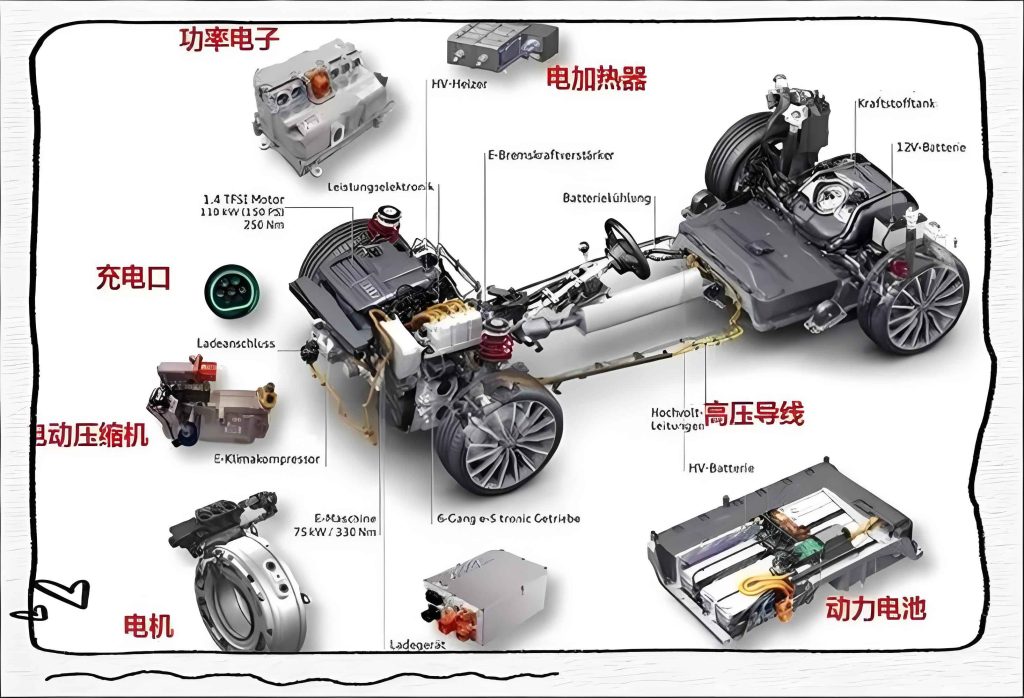
The sealing mechanism relies on generating sufficient contact stress between the gasket and the housing/flange surfaces. During assembly, fasteners are torqued, applying a clamping force that compresses the seal, creating a contact pressure distribution. A robust seal is maintained when this contact pressure remains greater than the pressure of the contained fluid or gas. Key factors influencing this performance include the surface finish of the mating flanges, the initial and long-term residual clamping force from fasteners, and the mechanical properties of the sealing material itself. In the operational lifecycle of an electric drive system, the assembly is subjected to vibrations from road irregularities, which can lead to a gradual attenuation of fastener preload, potentially compromising the seal. Therefore, a verification test must account for this dynamic environment.
1. Clamping Force Measurement Post-Vibration
To simulate real-world conditions, a specific type of motor controller unit for an electric drive system was subjected to a swept-frequency vibration test according to a standard automotive specification. The objective was to quantify the loss in fastener preload, a critical parameter for sealing integrity. The test profile is detailed in Table 1.
| Frequency (Hz) | Amplitude (mm) | Acceleration (m/s²) | Sweep Type | Duration per Sweep (min) | Number of Sweeps | Total Time per Axis (h) |
|---|---|---|---|---|---|---|
| 5 – 18.6 | 5.0 | – | Logarithmic | 20 | 30 | 10 |
| 18.6 – 50 | – | 68.6 | ||||
| 50 – 100 | – | 44.1 | ||||
| 100 – 200 | – | 29.4 |
The clamping force in the fasteners securing the sealing interface was monitored indirectly by measuring the tightening torque. The initial assembly torque was recorded. After completing the vibration test on the electric drive system enclosure, the residual fastening torque was measured using a precise electronic torque wrench (e.g., E-torc 2s). The method employed was the “loosening” or “breakaway” torque method, where the peak torque required to initiate rotation of the fastened joint is measured, corresponding to the transition from static to kinetic friction. This breakaway torque is a good indicator of the residual preload. A sample size of five fasteners for the sealing joint was used. The average residual torque was measured. Subsequently, to correlate torque with actual force, a clamping force sensor was used to establish the relationship between applied torque and axial clamping force for the specific fastener and joint configuration. The measured data is summarized in Table 2.
| Parameter | Sample 1 | Sample 2 | Sample 3 | Sample 4 | Sample 5 | Average |
|---|---|---|---|---|---|---|
| Initial Tightening Torque (Nm) | 6.32 | 6.08 | 6.16 | 6.21 | 6.40 | 6.23 |
| Residual Tightening Torque (Nm) | 5.98 | 5.36 | 5.71 | 5.66 | 5.90 | 5.72 |
| Residual Clamping Force (kN) | 4.76 | 4.27 | 4.55 | 4.51 | 4.70 | 4.59 |
Following the vibration test, a standard leak test was performed on the electric drive system enclosure. The test involved evacuating the sealed volume, allowing for stabilization, and then measuring the pressure rise over a specified period. The results, shown in Table 3, confirmed the integrity of the seal post-vibration, as the measured pressure differential was well within the acceptable limit.
| Enclosure Volume (L) | Evacuation Time (s) | Stabilization Time (s) | Test Duration (s) | Maximum Allowable Pressure Rise (Pa) | Measured Pressure Rise (Pa) | Result |
|---|---|---|---|---|---|---|
| 4.56 | 10 | 20 | 20 | 1000 | 200 | Pass |
2. Determination of Constitutive Model Parameters for the Sealing Element
The sealing gasket, typically made of Ethylene Propylene Diene Monomer (EPDM) rubber, exhibits hyperelastic behavior. Accurate finite element analysis of the sealing interface in an electric drive system requires a proper constitutive model to describe this behavior. The Mooney-Rivlin model is widely used for such applications. For planar seals, the design compression ratio usually falls within 15% to 30%. The two-parameter Mooney-Rivlin model provides sufficient accuracy for strains up to approximately 35%, making it suitable for this analysis.
The strain energy density function \( W \) for an incompressible (or nearly incompressible) material in the 1st order, 2-parameter Mooney-Rivlin form is given by:
$$ W = C_{10}(\bar{I}_1 – 3) + C_{01}(\bar{I}_2 – 3) + \frac{1}{d}(J – 1)^2 $$
where:
- \( \bar{I}_1 \) and \( \bar{I}_2 \) are the first and second deviatoric strain invariants.
- \( C_{10} \) and \( C_{01} \) are the material constants characterizing the shear behavior.
- \( J \) is the determinant of the elastic deformation gradient (volumetric ratio).
- \( d \) is the material incompressibility parameter, related to the initial bulk modulus \( K \) by \( d = 2/K \).
The initial shear modulus \( \mu \) is related to the constants by:
$$ \mu = 2(C_{10} + C_{01}) $$
For a uniaxial compression test, the relationship between engineering stress \( t_{11} \) and the stretch ratio \( \lambda \) (where \( \lambda = 1 + \epsilon \), and \( \epsilon \) is engineering strain) can be derived from the strain energy function. For incompressible material under uniaxial compression:
$$ t_{11} = 2(\lambda – \frac{1}{\lambda^2})(C_{10} + \frac{C_{01}}{\lambda}) $$
This equation allows for the determination of \( C_{10} \) and \( C_{01} \) by fitting to experimental data.
To characterize the specific EPDM compound (e.g., ER-2170H) used in the electric drive system seal, uniaxial compression tests were performed according to standard GB/T 7757. Five cylindrical specimens (Φ29 mm x 12.5 mm) were tested at controlled temperature (25.3°C) and humidity (61.2% RH) using a universal testing machine. The resulting stress-strain curves were obtained.
The experimental data points (engineering stress vs. engineering strain) were fitted to the derived uniaxial compression equation using a non-linear least squares regression algorithm. The quality of the fit was evaluated using the R-square value. The determined material constants for each sample and their average are presented in Table 4.
| Sample | C10 (MPa) | C01 (MPa) | R-square |
|---|---|---|---|
| 1 | -0.10 | 1.14 | 0.97 |
| 2 | -0.12 | 1.14 | 0.99 |
| 3 | -0.06 | 1.15 | 0.89 |
| 4 | -0.08 | 1.05 | 0.99 |
| 5 | -0.08 | 1.04 | 0.98 |
| Average / Representative | -0.088 | 1.104 | – |
The representative constants (e.g., from Sample 2 or the average) show a good fit to the experimental data within the design compression range. The negative value for \( C_{10} \) is not uncommon for certain rubber compounds and is acceptable as long as the combined model accurately represents the stress-strain response in the range of interest. This validated model is essential for performing a meaningful finite element analysis of the sealing interface in the electric drive system.
3. Finite Element Analysis of Contact Pressure
With the residual clamping force measured and the gasket material model defined, a finite element simulation was conducted to compute the contact pressure distribution on the sealing surface. The model comprised three main components: the cover plate (flange), the EPDM gasket, and the housing body containing the seal groove. The material properties and constitutive models assigned are summarized in Table 5.
| Component | Material | Constitutive Model | Model Parameters |
|---|---|---|---|
| Cover Plate | ADC12 (Aluminum Die Casting) | Linear Elastic | Young’s Modulus, \( E = 7.0 \times 10^4 \) MPa Poisson’s Ratio, \( \nu = 0.33 \) |
| Sealing Gasket | EPDM | Mooney-Rivlin (1st order, 2-parameter) | \( C_{10} = -0.1226 \) MPa \( C_{01} = 1.14 \) MPa (Incompressibility parameter \( d \) derived accordingly) |
| Housing Body | ADC12 | Linear Elastic | Young’s Modulus, \( E = 7.0 \times 10^4 \) MPa Poisson’s Ratio, \( \nu = 0.33 \) |
The boundary conditions were applied as follows: The housing body was fixed. The average residual clamping force of 4.59 kN, obtained from the vibration test, was applied as a concentrated load on the washer contact area under each fastener boss on the cover plate. “Tied” or frictionless contact was initially used to bond components, while surface-to-surface contact with a finite sliding formulation and appropriate friction coefficients (e.g., 0.3-0.5 for rubber-metal) was defined between the gasket and both the cover plate and the seal groove. The analysis was performed in two steps. First, a static structural analysis calculated the elastic deformation (warping) of the cover plate under the uneven clamping load distribution. The maximum deflection was found to be approximately 0.0175 mm. This deflection profile was then imported as a boundary condition for the gasket in a second step or coupled within a single analysis using contact interactions, simulating the actual compressed state of the gasket. The nominal gasket compression was 0.88 mm after accounting for cover plate deflection.
The FEA results provided the contact pressure distribution along the sealing line. The contour plot revealed that the minimum contact pressure generated between the EPDM gasket and the housing interface was greater than 2 MPa. This value must be compared against the maximum expected internal pressure of the medium within the electric drive system (e.g., coolant or air). For typical applications, this internal pressure is often below 0.4 MPa. Therefore, the analysis confirms that:
$$ P_{contact, min} \approx 2.0 \text{ MPa} > P_{medium} \approx 0.4 \text{ MPa} $$
This satisfies the fundamental sealing design criterion where the interfacial contact pressure must exceed the medium pressure to prevent leakage. This computational result is consistent with the successful outcome of the empirical post-vibration leak test conducted on the electric drive system unit.
4. Conclusion and Engineering Significance
This integrated experimental and numerical verification procedure provides a robust framework for validating the sealing performance of joint interfaces in electric drive systems. The methodology addresses the key practical concerns: the attenuation of fastener preload under dynamic vehicle operating conditions and the accurate representation of sealing material behavior.
By directly measuring the residual clamping force after standardized vibration testing, a realistic loading condition for the seal is established, moving beyond idealized assembly assumptions. The characterization of the EPDM gasket material through uniaxial compression tests and subsequent fitting to the Mooney-Rivlin hyperelastic model yields constitutive parameters with high confidence, enabling precise finite element analysis. The demonstration that a 1st order, 2-parameter Mooney-Rivlin model adequately fits the stress-strain data within the 15-30% compression range common in electric drive system seals provides a practical and efficient modeling approach for engineers.
The core finding, that the computed minimum contact pressure along the sealing line significantly surpasses the internal medium pressure even after accounting for vibration-induced preload loss and cover plate deformation, offers strong validation of the design’s integrity. This conclusion is further corroborated by the passing result of the physical leak test. This combined approach of physical testing (clamping force measurement, material characterization, leak testing) and virtual simulation (FEA) forms a comprehensive and reliable verification strategy. It not only validates a specific design but also establishes a generalizable protocol that can be applied to optimize seal geometry, fastener patterns, and material selection in the development of future, more advanced electric drive systems, ensuring their long-term reliability and performance in demanding automotive environments.