
As emission standards continue to tighten and traditional energy crises intensify, the transition to new energy vehicles is becoming imperative. For the heavy-duty truck sector, which is a major contributor to transportation emissions, electrification presents a viable path forward. The core of any electric vehicle’s powertrain is its electric drive unit. This component assembly, typically comprising a motor controller, electric motor, and reduction/transmission gearbox, is fundamentally different from traditional internal combustion engine systems. Its compact size, fewer ancillary parts, relatively simple architecture, and lower development cost offer significant flexibility. This flexibility allows for the design of various electric drive unit configurations to suit different vehicle packaging constraints and dynamic performance requirements. In this study, I will systematically categorize and analyze the different architectures of electric drive units for commercial vehicles. By evaluating their respective advantages and disadvantages in the context of demanding heavy-duty truck operations, I aim to identify the most suitable configurations and explore matching trends for this critical vehicle segment.
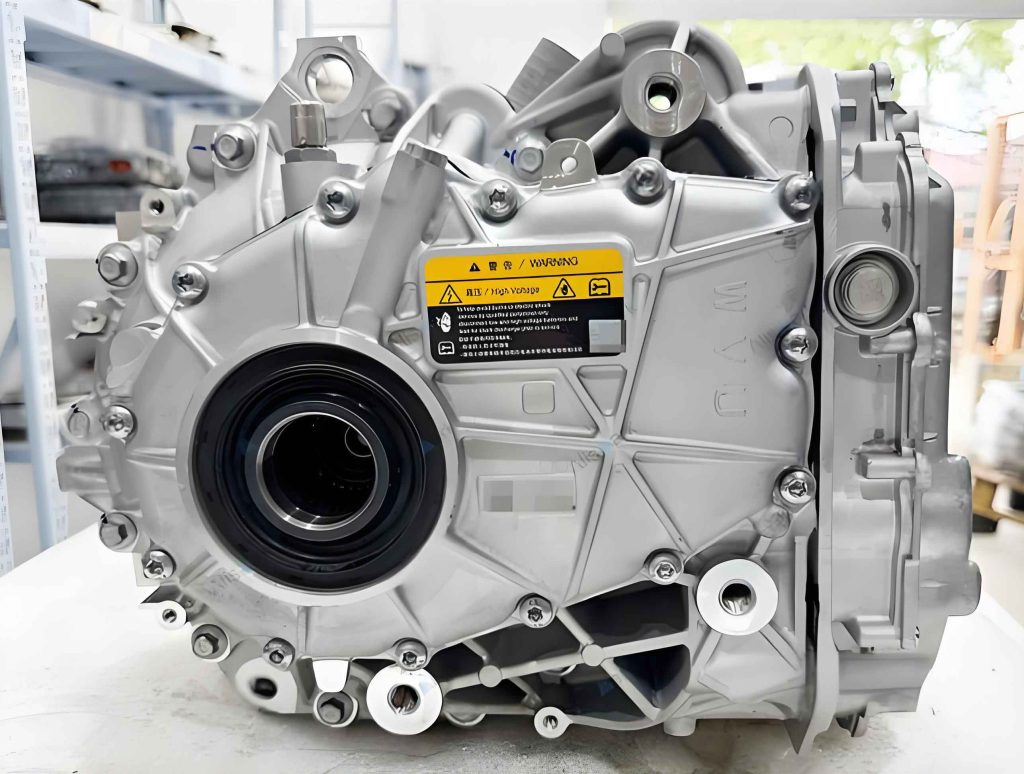
Classification of Electric Drive Unit Technical Pathways
The myriad of electric drive unit designs available stem from differences in several key areas: the location and method of unit packaging, the type and number of electric motors used, and the type of transmission device employed. For clarity, I will begin with a primary classification based on “unit packaging location and method,” followed by further subdivision based on other distinguishing features. The three primary categories are: Central Motor Drive, Electric Drive Axle, and Electric Wheel.
Central Motor Drive Configuration
This configuration adopts a layout similar to conventional trucks, where an electric motor coupled with a reduction/transmission unit is mounted centrally on the vehicle frame via a suspension system. The power flow from the motor onwards largely mirrors that of a traditional fuel-powered driveline. Based on the type of transmission device used, it can be further divided into three sub-types.
Direct Drive (Motor + Propeller Shaft + Traditional Axle): This is the simplest form of central drive. The electric motor connects directly to a traditional axle via a propeller shaft. Its main advantage lies in its structural simplicity and high transmission efficiency. However, the significant drawback is that speed and torque regulation are confined strictly to the motor’s own output characteristics. It cannot simultaneously accommodate both the high-torque requirements for starting/climbing and the high-speed demands for cruising. Therefore, this electric drive unit configuration is generally suitable for medium and small buses, light trucks, and some low-speed operational scenarios where dynamic performance needs are moderate.
Motor + Reducer (Motor + Reducer + Propeller Shaft + Traditional Axle): This configuration introduces a fixed-ratio reducer between the motor and the propeller shaft. The reducer amplifies the output torque, thereby reducing the torque demand on the motor itself. While this improves launch capability, it narrows the effective speed range. This type of electric drive unit is well-suited for applications like mining trucks that operate at relatively low speeds but have exceptionally high torque requirements.
Motor + AMT (Automated Manual Transmission): This approach pairs the electric motor with a multi-speed automated manual transmission. The multiple gear ratios allow for a much wider range of speed and torque regulation. This enables the electric drive unit to meet both dynamic performance (acceleration, gradeability) and economic (efficiency at various speeds) requirements across diverse driving conditions. Consequently, the motor + AMT electric drive unit is considered the optimal choice for most medium and heavy-duty trucks within the central drive category, as it best balances the competing demands of power and range.
Electric Drive Axle Configuration
This configuration represents a significant integration step. The motor and reduction/transmission unit are integrated directly onto the axle assembly. This eliminates the need for separate powertrain mounts, the propeller shaft, and sometimes other components. The benefits are a higher degree of integration, improved transmission efficiency (due to a shorter power path), and reduced overall weight. Electric drive axles can be classified based on motor placement and transmission type.
Centralized Electric Drive Axle: Here, the motor and transmission/reducer are integrated into the center of the drive axle, with power distributed to the wheels via a differential. Based on the spatial relationship between the motor’s axis and the axle’s axis, there are three main layouts, as summarized in the table below.
| Layout Type | Description | Key Characteristics for Heavy-Duty Use |
|---|---|---|
| Parallel-Axis | Motor axis is parallel to the axle axis, connected via gears. | Offers the best balance of cost, reliability, maintainability, and efficiency. Most suitable for the complex and demanding operating conditions of heavy-duty trucks. |
| Co-Axial | Motor rotor is mounted co-axially with the axle input. | Can be more compact in length but often involves more complex gearing (e.g., planetary sets), potentially impacting cost and reliability. |
| Vertical-Axis (Right-Angle) | Motor axis is perpendicular to the axle axis, requiring a bevel gear set. | May offer packaging benefits in some chassis layouts but typically has lower mechanical efficiency compared to parallel-axis designs. |
Central Distributed (Dual-Motor) Electric Drive Axle: This configuration features two electric motors integrated into the central axle housing, each driving one wheel independently via a dedicated reducer. A key distinction is the absence of a mechanical differential; torque vectoring is achieved electronically through motor control. Advantages include reduced mechanical losses (no differential) and seamless power delivery without gear shift interruptions. However, the economic speed range is typically narrower due to the single fixed gear ratio for each motor. This makes the electric drive unit of this type ideal for segments with relatively constant cruising speeds.
Wheel-side / Wheel-hub Distributed Electric Drive Axle: This architecture takes integration a step further by placing the motor and reduction unit at each wheel end, either on the axle beam (wheel-side) or inside the wheel hub itself. This completely eliminates the half-shafts, shortening the power path even more. While promising for ultimate efficiency and modularity, it presents major challenges for heavy-duty use: harsh operating environments (vibration, impact, contamination), limited space for packaging and cooling, and high unsprung mass in the case of wheel-hub motors. Therefore, this electric drive unit configuration is currently not considered practical for most heavy-duty truck applications.
Electric Wheel Configuration
This represents the pinnacle of integration, where the motor and reduction mechanism are housed entirely within the wheel hub. It often integrates braking and suspension functions into a highly modular unit. This offers tremendous flexibility for vehicle design and scalability. However, it magnifies the challenges of the wheel-hub distributed axle—extreme packaging constraints, severe thermal management issues, and very high unsprung mass—making its application in current medium and heavy-duty trucks exceedingly difficult. It remains a topic for future technological advancement.
Comparative Analysis of Electric Drive Unit Configurations Suitable for Heavy-Duty Truck Applications
Based on the analysis above, three electric drive unit configurations emerge as practically suitable for the rigorous demands of the heavy-duty truck market: the Central Motor Drive with AMT (Motor+AMT), the Centralized Electric Drive Axle (specifically the parallel-axis type), and the Central Distributed Electric Drive Axle. I will now conduct a detailed comparative analysis of these three, focusing on aspects critical to heavy-duty operations.
Comparison of Packaging Space and Driveline Simplification
These three configurations are not isolated but exist on a continuum of increasing integration. One can view the progression from Motor+AMT to Centralized E-Axle to Distributed E-Axle as a series of steps to save space and shorten the driveline.
The transition from a Motor+AMT to a Centralized Electric Drive Axle involves removing the propeller shaft and physically integrating the motor and transmission with the axle housing. To fit within the axle’s spatial constraints, this typically necessitates switching from a large, low-speed high-torque motor to a more compact high-speed motor. The multi-speed AMT is also often replaced by a gearbox with fewer speeds (e.g., 2 or 4), which is then integrated with the axle’s final drive. This integration shortens the mechanical power path, reduces weight by approximately 25%, and can improve overall transmission efficiency by 2-3% by eliminating losses in the propeller shaft U-joints and simplifying the gearing.
Progressing further to a Central Distributed Electric Drive Axle involves removing the mechanical differential and simplifying the gearbox on each side to a single-ratio reducer. This further shortens the power path, reduces weight by an additional ~5%, and can improve efficiency by another 0.5-1% by eliminating differential gear losses.
This clear evolution shows that electric drive axle configurations hold significant advantages in weight and efficiency over the Motor+AMT setup. This makes them particularly attractive for highway transportation markets where economic performance (energy consumption) and payload capacity (directly affected by powertrain weight) are paramount.
Dynamic Performance: Motor+AMT vs. Electric Drive Axles
A key metric for heavy trucks, especially in construction and mining, is gradeability. Let’s compare a mainstream 250 kW Motor+AMT system with a 260 kW Centralized Electric Drive Axle. While their peak power is similar, the torque characteristics differ substantially.
- Motor+AMT: Uses a low-speed motor with a high rated torque (e.g., 1800 Nm). Coupled with a multi-speed AMT and the axle’s final drive, it achieves a very wide overall drive ratio range.
- Centralized E-Axle: Employs a high-speed motor with a lower rated torque (e.g., 800 Nm). Due to packaging limits on the axle, the maximum achievable final drive ratio is often lower than what can be packaged with a separate axle.
Assuming identical vehicle parameters (gross weight, rolling resistance coefficient, frontal area, etc.) except for the powertrain, we can assess maximum gradeability using the vehicle dynamics equation for steady-state climbing:
$$F_t = F_f + F_w + F_i = mgf \cos\alpha + \frac{1}{2} C_D A \rho u^2 + mg \sin\alpha$$
Where \(F_t\) is the traction force at the wheel, \(m\) is vehicle mass, \(g\) is gravity, \(f\) is rolling resistance coefficient, \(\alpha\) is grade angle, \(C_D\) is drag coefficient, \(A\) is frontal area, \(\rho\) is air density, and \(u\) is vehicle speed. At very low speeds on a steep grade, the aerodynamic force \(F_w\) is negligible. The maximum tractive force is limited by the maximum torque from the electric drive unit and the total gear reduction. The relationship between wheel torque \(T_w\) and motor torque \(T_m\) is:
$$T_w = T_m \cdot i_g \cdot i_0 \cdot \eta_t$$
Where \(i_g\) is transmission ratio, \(i_0\) is final drive ratio, and \(\eta_t\) is transmission efficiency. The traction force is \(F_t = T_w / r\), where \(r\) is the wheel radius. The gradeability (\(i = \tan\alpha\), expressed as a percentage for small angles) can be approximated for low-speed climbing as:
$$i_{max} \approx \frac{T_{m, max} \cdot i_g \cdot i_0 \cdot \eta_t}{m g r} – f$$
For our example, let’s assume the Motor+AMT system has a maximum motor torque \(T_{m,max,M+AMT} = 3500\) Nm (including potential overload), a selected crawler gear ratio \(i_{g,low} = 15.0\), a final drive ratio \(i_{0,M+AMT} = 4.7\), efficiency \(\eta_t = 0.94\), wheel radius \(r = 0.52\) m, mass \(m=25000\) kg, and \(f=0.02\).
$$i_{max, M+AMT} \approx \frac{3500 \cdot 15.0 \cdot 4.7 \cdot 0.94}{25000 \cdot 9.81 \cdot 0.52} – 0.02 \approx 0.387 \text{ or } 38.7\%$$
For the Centralized E-Axle, assume \(T_{m,max,E-Axle} = 1600\) Nm, a low gear ratio \(i_{g,low} = 4.0\), a maximum achievable final drive ratio \(i_{0,E-Axle} = 20.15\), and efficiency \(\eta_t = 0.96\).
$$i_{max, E-Axle} \approx \frac{1600 \cdot 4.0 \cdot 20.15 \cdot 0.96}{25000 \cdot 9.81 \cdot 0.52} – 0.02 \approx 0.153 \text{ or } 15.3\%$$
This calculation clearly shows the superior gradeability of the Motor+AMT electric drive unit, making it the preferred choice for engineering vehicles, dump trucks, and other applications operating in rugged terrain with steep gradients.
Economic Performance: Centralized vs. Distributed Electric Drive Axle
The economic efficiency of an electric drive unit is heavily influenced by how well it keeps the motor operating within its highest efficiency zone across the vehicle’s speed range. The primary difference here lies in the breadth of the “economical speed range.”
A Centralized Electric Drive Axle with a 2 or 4-speed gearbox can use gear shifts to adjust the relationship between vehicle speed and motor speed. This allows the motor to operate near its peak efficiency at both low and high vehicle speeds. In contrast, a Central Distributed Electric Drive Axle with a single fixed ratio has only one mapping between vehicle speed and motor speed. Its motor will only be in the high-efficiency zone within a specific, narrower vehicle speed band.
We can quantify this using the vehicle speed formula:
$$u = 0.377 \frac{n r}{i_0 i_g}$$
Where \(u\) is vehicle speed in km/h, \(n\) is motor speed in rpm, and \(r\) is wheel radius in meters.
Consider two electric drive units of similar power:
- Centralized E-Axle: Motor high-efficiency range is 1800 – 6200 rpm. It has two effective gear ratios: a low gear (\(i_0 i_g = 50.3\)) and a high gear (\(i_0 i_g = 15.2\)). Wheel radius \(r = 0.52\) m.
- Distributed E-Axle: Motor high-efficiency range is 4200 – 9300 rpm. It has a single fixed ratio \(i_0 i_g = 20.2\). Wheel radius \(r = 0.52\) m.
Calculating the economical speed ranges:
For the Centralized E-Axle:
- Low Gear, min speed: \(u = 0.377 \cdot (1800 \cdot 0.52) / 50.3 \approx 7.0\) km/h
- Low Gear, max speed: \(u = 0.377 \cdot (6200 \cdot 0.52) / 50.3 \approx 24.2\) km/h (shift point)
- High Gear, min speed (after shift): \(u = 0.377 \cdot (1800 \cdot 0.52) / 15.2 \approx 23.2\) km/h
- High Gear, max speed: \(u = 0.377 \cdot (6200 \cdot 0.52) / 15.2 \approx 80.0\) km/h
Thus, its combined economical speed range is approximately 7 to 80 km/h.
For the Distributed E-Axle:
- Min economical speed: \(u = 0.377 \cdot (4200 \cdot 0.52) / 20.2 \approx 40.7\) km/h
- Max economical speed: \(u = 0.377 \cdot (9300 \cdot 0.52) / 20.2 \approx 90.9\) km/h
Thus, its economical speed range is approximately 41 to 91 km/h.
This analysis reveals that the distributed electric drive unit has a strong economic advantage, but only within a specific, higher speed band. This makes it perfectly suited for long-haul, line-haul transportation where the truck operates predominantly at steady highway speeds (e.g., 80-90 km/h). The centralized electric drive unit, with its wider economical range, offers better efficiency across a more varied duty cycle, including urban and regional delivery routes with frequent stops and lower average speeds.
Summary and Configuration Selection Guidance
Through this systematic study, I have categorized electric drive unit configurations and performed a detailed analysis tailored to the heavy-duty truck sector. The selection of the optimal electric drive unit is not a one-size-fits-all decision but must be driven by the specific operational profile of the vehicle.
The following table summarizes the key findings and provides guidance for matching the electric drive unit configuration to the appropriate heavy-duty truck segment:
| Electric Drive Unit Configuration | Key Strengths | Key Limitations | Recommended Heavy-Duty Application Segment |
|---|---|---|---|
| Central Motor + AMT | Superior gradeability and dynamic performance; widest speed/torque regulation; leverages some existing driveline components. | Larger packaging space; heavier; longer driveline with slightly lower efficiency. | Construction vehicles (dump trucks, mixers), mining vehicles, off-road trucks – where extreme torque and climb ability are critical. |
| Centralized (Parallel-Axis) Electric Drive Axle | Excellent balance of efficiency, weight, reliability, and cost; good packaging; wider economical speed range than distributed axles. | Lower maximum gradeability than Motor+AMT; integration complexity. | Regional haul, distribution trucks, general freight – where a balance of efficiency, performance, and payload is needed across varied routes. |
| Central Distributed (Dual-Motor) Electric Drive Axle | Highest potential efficiency within its optimal band; very compact driveline; no gear-shift interruption; torque vectoring capability. | Narrow economical speed range; higher cost and complexity of dual inverters/motors; no mechanical differential backup. | Long-haul, line-haul trucks operating primarily on highways at constant high speeds – where maximizing range (energy efficiency) is the top priority. |
In conclusion, the evolution of the electric drive unit for heavy-duty trucks is moving decisively towards higher integration, as seen in electric drive axles, to save weight and improve efficiency. However, the choice between a Motor+AMT, a centralized e-axle, and a distributed e-axle hinges on the primary operational demands. For maximum power, the Motor+AMT electric drive unit remains unrivaled. For maximum highway efficiency, the distributed e-axle electric drive unit shows great promise. For the broadest appeal across many duty cycles, the centralized parallel-axis electric drive unit offers a compelling and versatile solution. Understanding these trade-offs is essential for successfully deploying electric drive units in the diverse and demanding world of heavy-duty transportation.