
The evolution towards vehicle electrification and intelligence imposes unprecedented demands on automotive electronic control systems. These systems are now required to execute rapid, coordinated responses to complex and dynamic road conditions, optimize the distribution of motive power with high precision, and simultaneously minimize energy consumption. The limitations of traditional control strategies, which often rely on pre-defined rule-based logic and localized feedback loops, become starkly apparent under extreme operating scenarios. For instance, during sharp cornering on icy surfaces, a conventional system may struggle to adapt to the dynamically changing tire-road friction coefficients, applying drive torque in a fixed proportion that can lead to unilateral wheel spin and induce vehicle roll. Similarly, in high-speed emergency obstacle avoidance, the delayed or uncoordinated response between braking and steering subsystems, each operating on limited local information, can cause the vehicle to deviate from the intended evasion path or even induce a spin. The fundamental challenge lies in the insufficient adaptability of traditional control logic to the multidimensional and nonlinear dynamics of the vehicle-environment interaction.
The advent of high-level automated driving (L3 and above), which promises autonomous decision-making in complex scenarios like urban congestion and adverse weather, raises the performance bar even higher. Requirements for trajectory precision, such as centimeter-level lane keeping, and stabilization speed, such as correcting vehicle attitude within 500 milliseconds, far exceed the capabilities of conventional architectures. This gap underscores the critical need for a more sophisticated, predictive, and adaptive control paradigm.
Mathematical algorithms provide the essential framework to bridge this gap. The core philosophy involves transforming the complex physical processes of vehicle motion into quantifiable mathematical models and optimization problems. State information—including vehicle speed, steering angle, longitudinal and lateral acceleration—streams in from sensor arrays. This raw data is filtered and fused using algorithms like the Kalman filter to generate accurate state estimates. These estimates populate a state-space model that encapsulates the vehicle’s dynamics. Furthermore, nonlinear relationships, such as those between driver intent (expressed via pedal stroke, steering wheel angle) and available road grip (estimated from wheel speed differences and slip ratios), are approximated or learned using advanced techniques like neural networks or exploited within optimization frameworks like Model Predictive Control (MPC). The control objective is then formulated as a problem of minimizing a cost function (e.g., tracking error, energy use, control effort) subject to the derived model and a set of hard constraints (e.g., actuator limits, stability boundaries). This mathematical formulation allows the central motor control unit or integrated domain controller to solve for the optimal set of control inputs—such as individual wheel brake pressures, steering torque, and drive motor torques—within millisecond timescales. This essay, therefore, delves into the optimization of intelligent vehicle electronic control systems driven by mathematical algorithms. It aims to elucidate how the construction of precise mathematical models and the implementation of efficient real-time solving strategies can significantly enhance the system’s responsiveness and control accuracy in dynamic environments, thereby providing a crucial technical reference for the widespread deployment of advanced automated driving.
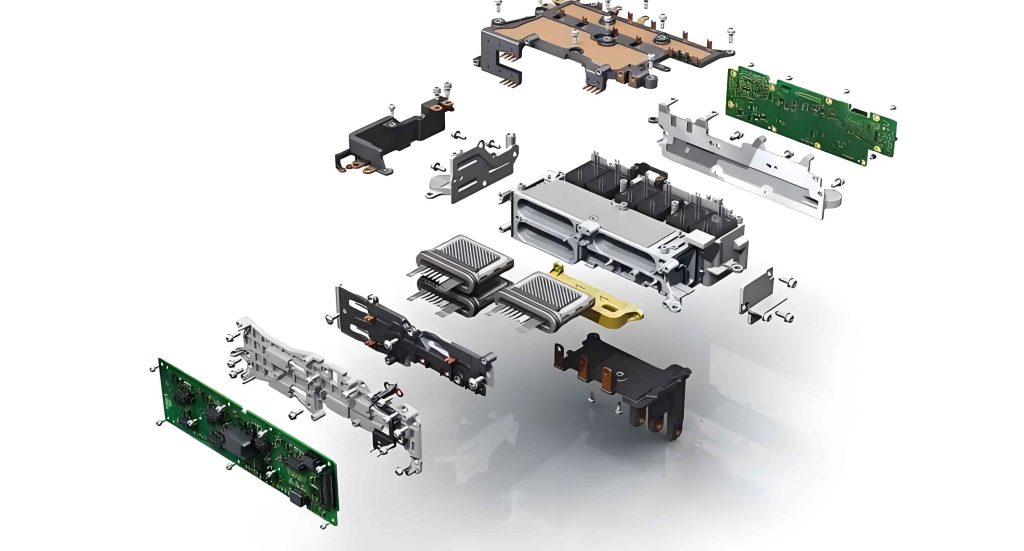
The intelligent vehicle’s electronic control system is a sophisticated, networked ecosystem of electronic control units (ECUs), sensors, and actuators. It functions as the central nervous system, continuously acquiring data on vehicle operating states, processing this information through algorithmic cores, and issuing precise command signals to various functional modules for fine-tuned regulation. The seamless coordination between core modules is paramount. The following table summarizes the primary modules, their monitoring targets, and their core functions within this collaborative framework.
| Control Module | Primary Monitoring/Sensing Targets | Core Function & Collaborative Role |
|---|---|---|
| Engine Control Module (ECM) / Powertrain Motor Control Unit | Air intake mass, fuel injection volume, ignition timing, engine load, temperature. | Precisely controls fuel injection, ignition timing (for ICE), or torque output (for electric motors) to optimize efficiency and power delivery. Collaborates with TCM and BCM for coordinated coasting, braking energy recuperation, and load management. |
| Transmission Control Module (TCM) | Driver intent (accelerator/brake pedal), vehicle speed, engine/motor speed, current gear. | Analyzes driving intent and vehicle state to automatically select the optimal gear or manage gearbox ratio (in EVs), ensuring efficient power transmission and responsiveness. |
| Brake Control Module (BCM) | Brake pedal force and travel, individual wheel speeds. | Implements Anti-lock Braking System (ABS) logic, preventing wheel lock-up by modulating brake pressure at each wheel. Maintains steering capability during hard braking. Provides the foundational actuator control for ESC interventions. |
| Electronic Stability Control (ESC) | Vehicle yaw rate, lateral acceleration, steering wheel angle, individual wheel speeds. | Detects deviations between the driver’s intended path (from steering input) and the vehicle’s actual path. Corrects understeer or oversteer by applying selective braking to individual wheels, generating a counteracting yaw moment to stabilize the vehicle. |
| Integrated Chassis Domain Controller (Modern Architecture) | Consolidated data from all dynamic sensors (inertial, wheel, steering). | Acts as a superior motor control unit for vehicle motion. Executes high-level motion control algorithms (e.g., Torque Vectoring, advanced ESC) by coordinating commands to the brake, steering, and powertrain subsystems for holistic dynamics management. |
The effectiveness of the integrated control strategy hinges on a rigorous mathematical foundation. Accurate modeling of vehicle dynamics is the first pillar.
Mathematical Modeling Foundation for Intelligent ECS
1. Vehicle Dynamics Equation Formulation
To quantify the vehicle’s motion characteristics during maneuvers, a simplified yet powerful model is essential for real-time computation. The two-degree-of-freedom “bicycle model” is widely employed to describe the coupled relationship between lateral and yaw motions. This model simplifies the vehicle to a rigid body moving on a plane, focusing on two key degrees of freedom at the center of gravity (CoG): lateral velocity ($v$) and yaw rate ($\gamma$). Newton’s second law yields the governing equations.
Lateral Force Balance Equation (along the vehicle-fixed y-axis):
$$m(\dot{v} + u\gamma) = F_{yf} + F_{yr}$$
Here, $m$ is the vehicle mass, $u$ is the longitudinal velocity at the CoG, $\dot{v}$ is the lateral acceleration, $F_{yf}$ and $F_{yr}$ are the total lateral forces generated at the front and rear axles, respectively. This equation balances the inertial forces arising from lateral motion with the tire lateral grip forces.
Yaw Moment Balance Equation (about the vehicle-fixed z-axis):
$$I_z \dot{\gamma} = l_f F_{yf} – l_r F_{yr}$$
In this equation, $I_z$ is the vehicle’s yaw moment of inertia, $\dot{\gamma}$ is the yaw acceleration, $l_f$ and $l_r$ are the distances from the CoG to the front and rear axles. The term $l_f F_{yf}$ represents the moment promoting increased yaw (from the front axle), while $-l_r F_{yr}$ represents the moment tending to reduce yaw (from the rear axle). The interplay between these moments determines the vehicle’s steering response: if $l_f F_{yf} > |l_r F_{yr}|$, the vehicle exhibits oversteer tendency; if $l_f F_{yf} < |l_r F_{yr}|$, it shows understeer tendency. The integrated motor control unit uses these relationships to estimate the desired yaw rate and lateral forces for stability, and then calculates the necessary corrective yaw moment, often achieved by differential braking.
The lateral forces $F_{yf}$ and $F_{yr}$ are nonlinear functions of tire slip angles ($\alpha_f$, $\alpha_r$) and normal load. For control-oriented design, a linear approximation is often used near a nominal operating point:
$$F_{yf} \approx C_{\alpha f} \alpha_f, \quad F_{yr} \approx C_{\alpha r} \alpha_r$$
where $C_{\alpha f}$ and $C_{\alpha r}$ are the cornering stiffness coefficients of the front and rear axles. The slip angles are related to the states: $\alpha_f \approx \delta – \frac{v + l_f \gamma}{u}$ and $\alpha_r \approx -\frac{v – l_r \gamma}{u}$, with $\delta$ being the front steering angle. Substituting these into the force balance equations yields a linear state-space model suitable for controller design:
$$
\begin{bmatrix}
\dot{v} \\[6pt]
\dot{\gamma}
\end{bmatrix} =
\begin{bmatrix}
-\frac{C_{\alpha f}+C_{\alpha r}}{m u} & -u – \frac{l_f C_{\alpha f} – l_r C_{\alpha r}}{m u} \\[6pt]
-\frac{l_f C_{\alpha f}-l_r C_{\alpha r}}{I_z u} & -\frac{l_f^2 C_{\alpha f}+l_r^2 C_{\alpha r}}{I_z u}
\end{bmatrix}
\begin{bmatrix}
v \\[6pt]
\gamma
\end{bmatrix} +
\begin{bmatrix}
\frac{C_{\alpha f}}{m} \\[6pt]
\frac{l_f C_{\alpha f}}{I_z}
\end{bmatrix}
\delta
$$
2. System Constraint Quantification Methodology
A complete mathematical model for control must incorporate explicit constraints; otherwise, the optimization may yield solutions that are physically impossible or unsafe. Constraints arise from three primary layers: physical actuator limits, control input boundaries, and operational safety envelopes. These must be translated into mathematical inequalities or equalities within the optimization framework.
| Constraint Layer | Physical Origin | Mathematical Quantification |
|---|---|---|
| Physical Actuator & Tire Limits | Maximum force/torque output of brakes, steering, drive motors. Maximum frictional force a tire can generate (friction ellipse concept). | $ |F_{x,i}| \le \mu F_{z,i}$, $ |F_{y,i}| \le \mu F_{z,i}$ $ |T_{motor}| \le T_{max}( \omega)$ $ \delta_{min} \le \delta \le \delta_{max}$, $ |\dot{\delta}| \le \dot{\delta}_{max}$ $ 0 \le P_{brake, i} \le P_{max}$ |
| Control Input Bounds | Hardware limits on commanded signals and their rates of change to prevent damage or instability. | $ u_{min} \le u(t) \le u_{max}$ $ |\dot{u}(t)| \le \dot{u}_{max}$ (Where $u$ represents a generic control input vector) |
| Operational Safety Boundaries | Maintaining vehicle stability (no rollover, excessive slip). Adhering to traffic rules and keeping a safe distance from obstacles. | $ |a_y| \le \mu g / \eta$ (with safety factor $\eta$) $ |\gamma – \gamma_{des}| \le \Delta \gamma_{max}$ $ d_{obs}(t) \ge d_{safe}$ Vehicle states within stability region $\Omega$ |
The combined set of differential equations (dynamics model) and algebraic inequalities/equalities (constraints) forms the complete mathematical framework. The central motor control unit continuously solves optimization problems within this feasible solution space to determine the safest and most effective control actions.
Optimization of the Intelligent ECS via Mathematical Algorithms
The true power of the mathematical approach is realized in the synthesis of real-time optimization algorithms that leverage the models and constraints described above. Two critical application domains are trajectory planning and torque vectoring.
1. Real-Time Trajectory Optimization for Path Planning
Dynamic path planning is not merely about finding a collision-free route; it’s about computing a kinematically and dynamically feasible trajectory that optimizes multiple objectives like comfort, safety, and efficiency over a receding horizon. This is typically formulated as a Model Predictive Control (MPC) problem. Let $x_k$ represent the vehicle state (position, velocity, heading, etc.) at time step $k$, and $u_k$ the control inputs (steering angle, acceleration). The discrete-time vehicle model is $x_{k+1} = f(x_k, u_k)$. Given a reference path $x^{ref}$, the MPC solves, at each time step, the following constrained finite-horizon optimal control problem:
$$
\begin{aligned}
\min_{U} \quad & \sum_{k=0}^{N-1} \left( \|x_k – x^{ref}_k\|^2_Q + \|u_k\|^2_R \right) + \|x_N – x^{ref}_N\|^2_{P} \\
\text{subject to} \quad & x_{k+1} = f(x_k, u_k), \quad k = 0,\ldots,N-1 \\
& x_0 = x(t) \quad \text{(current measured state)} \\
& u_{min} \le u_k \le u_{max}, \quad k = 0,\ldots,N-1 \\
& g(x_k, u_k) \le 0, \quad k = 0,\ldots,N \quad \text{(obstacle & dynamics constraints)}
\end{aligned}
$$
Here, $U = [u_0, u_1, …, u_{N-1}]$ is the sequence of control inputs over the prediction horizon $N$. The matrices $Q$, $R$, and $P$ are weighting matrices that penalize tracking error, control effort, and terminal state error, respectively. The function $g(x_k, u_k)$ encapsulates all inequality constraints from the previous section (e.g., acceleration limits, distance to obstacles). The motor control unit solves this optimization problem repeatedly, applying only the first control input $u_0^*$ from the optimal sequence before recalculating with new sensor data at the next time step, thereby enabling reactive and optimal path following.
2. Optimal Drive Force Distribution (Torque Vectoring)
For vehicles with multiple independent drive motors (common in electric vehicles), or those with active differentials, the motor control unit has direct authority over the longitudinal force at each wheel. This enables torque vectoring, a powerful technique to enhance stability, agility, and efficiency. The control objective is to determine the optimal set of wheel torques $T_i$ (where $i = FL, FR, RL, RR$) to achieve a desired total longitudinal force $F_{x,des}$ and a desired direct yaw moment $M_{z,des}$ (often from the ESC or the driver’s steering input).
The relationship between wheel torques, vehicle forces, and yaw moment is given by (ignoring drivetrain losses for simplicity):
$$
\begin{aligned}
F_{x, des} &= \frac{1}{r} (T_{FL} + T_{FR} + T_{RL} + T_{RR}) \\
M_{z, des} &= \frac{t_f}{2r} (T_{FR} – T_{FL}) + \frac{t_r}{2r} (T_{RR} – T_{RL})
\end{aligned}
$$
where $r$ is the tire effective radius, and $t_f$, $t_r$ are the front and rear track widths. This system is underdetermined (two equations, four unknowns), allowing for optimization. A common formulation is to minimize total power loss or maximize efficiency while satisfying the force/moment demands and adhering to tire friction constraints:
$$
\begin{aligned}
\min_{T_i} \quad & \sum_{i} (T_i \omega_i)^2 \quad \text{or} \quad \sum_{i} \frac{F_{x,i}^2}{\mu^2 F_{z,i}^2} \\
\text{subject to} \quad & \frac{1}{r} \sum T_i = F_{x,des} \\
& \frac{t_f}{2r} (T_{FR} – T_{FL}) + \frac{t_r}{2r} (T_{RR} – T_{RL}) = M_{z,des} \\
& |F_{x,i}| = \left|\frac{T_i}{r}\right| \le \mu F_{z,i} \quad \forall i \\
& T_{i,min}(\omega_i) \le T_i \le T_{i,max}(\omega_i)
\end{aligned}
$$
The first objective approximates electrical losses (proportional to power), while the second, known as the “friction circle utilization” objective, tries to keep tire forces away from their saturation limits, preserving stability margin. The central motor control unit solves this quadratic programming (QP) problem in real-time. The solution dictates, for example, how to split torque during aggressive cornering: reducing torque on the inner wheels (which have lower vertical load and thus less grip capacity) and increasing it on the outer wheels to generate the required yaw moment without provoking wheel spin. On low-friction surfaces, the optimizer ensures the sum of allocated wheel forces does not exceed the total available grip, dynamically adjusting to prevent loss of traction.
Advanced Algorithmic Implementations and Future Trajectories
The journey towards fully optimized vehicle motion control extends beyond linear MPC and basic QP. Several advanced algorithmic frontiers are being actively explored to handle the inherent complexities and uncertainties of real-world driving.
Robust and Stochastic MPC: Standard MPC assumes a perfect model and known disturbances. Robust MPC explicitly accounts for bounded model uncertainties, guaranteeing constraint satisfaction under a “worst-case” scenario, albeit often conservatively. Stochastic MPC, on the other hand, treats uncertainties (e.g., road friction variation, wind gusts) as random variables with known distributions, optimizing the expected value of the cost function. This allows the motor control unit to make less conservative, risk-aware decisions. The optimization problem incorporates chance constraints, such as $P( a_y(t) > a_{y,max} ) \le \epsilon$, ensuring the probability of violating a safety limit is below a small threshold $\epsilon$.
Learning-Based Enhancements: Machine learning algorithms are increasingly integrated into the mathematical control framework. Deep neural networks can be used to learn highly accurate, nonlinear tire models or complex vehicle dynamics from data, which are then embedded within the MPC’s prediction model. Reinforcement Learning (RL) offers a paradigm where the control policy (the mapping from state to action) is learned through trial-and-error interactions with a simulated or real environment. A hybrid approach, often most promising, uses MPC as the primary safety-critical controller but employs a learned policy to provide a high-quality initial guess for the optimization solver or to adapt the cost function weights online based on driving style, dramatically reducing the computational solve time.
Multi-Agent Coordination for Platooning: In connected vehicle scenarios, the optimization scope expands from a single vehicle to a group (platoon). Here, a distributed MPC framework is employed. Each vehicle’s motor control unit solves its own local optimization problem but includes coupling constraints or cost terms related to its immediate neighbors (e.g., maintaining a safe, constant time gap). Information such as intended acceleration is shared via Vehicle-to-Vehicle (V2V) communication. The collective solution minimizes the total fuel/energy consumption of the platoon while ensuring string stability (preventing amplification of disturbances down the line). The coupled optimization problem for vehicle $i$ in a platoon might include a term like $\sum_{k} (d_i(k) – d_{des,i}(k))^2$ in its cost function, where $d_i$ is the distance to the preceding vehicle and $d_{des,i}$ is the desired spacing policy, which is a function of the states of both vehicles.
The ultimate goal is the realization of a unified, adaptive, and supremely robust vehicle motion controller. This next-generation motor control unit will seamlessly blend first-principles models with data-driven learning, employ fast and reliable non-convex solvers, and operate within a fail-operational architectural framework. It will not only react to imminent hazards but also proactively plan maneuvers that synergize safety, passenger comfort, and energy efficiency over a long planning horizon, truly embodying the mathematical intelligence at the heart of the autonomous driving revolution.