
The global push for electric vehicles (EVs) as a cornerstone of sustainable transportation and climate change mitigation is undeniable. Major automotive nations and corporations have elevated this transition to a strategic priority, evidenced by ambitious plans and significant investments. While cumulative sales figures, notably from China, demonstrate progress, the widespread adoption of EVs continues to face fundamental hurdles related to driving range, safety, and cost. The prevalent strategy of simply adding more battery cells to increase range leads to heavier vehicles, higher energy consumption, and elevated costs throughout the vehicle’s lifecycle. The fundamental solution, therefore, lies in a radical improvement in battery performance metrics, particularly energy density and intrinsic safety.
Historically, leaps in battery performance have been driven by revolutionary changes in the battery materials system. We have witnessed this progression from first-generation nickel-metal hydride and lithium manganese oxide batteries, to second-generation lithium iron phosphate (LFP), and now to the widely adopted third-generation ternary (NMC/NCA) lithium-ion batteries. Each step brought increases in energy density and reductions in cost. Determining the optimal battery system for the 2020-2025 timeframe and beyond is therefore critical. Among the various novel battery systems under investigation, the solid-state battery stands out. By replacing the conventional flammable organic liquid electrolyte and separator with a solid-state electrolyte, it offers a paradigm shift with the potential to become the ultimate solution for next-generation electric vehicles.
The promise of the solid-state battery stems from its core characteristics. Traditional lithium-ion batteries with liquid electrolytes pose safety risks like leakage, thermal runaway, and fire under conditions such as overcharge or internal short circuits. In contrast, a solid-state battery employs a non-flammable, non-volatile solid electrolyte, inherently eliminating these hazards and earning its reputation as the safest battery architecture. Regarding energy density, national goals in the US, China, and Japan target 400-500 Wh/kg by 2020 and mass production by 2025-2030. Achieving these targets is widely believed to necessitate the use of a lithium metal anode. Metallic lithium presents severe challenges in liquid electrolytes, including dendrite growth, pulverization, and unstable solid-electrolyte interphase (SEI) formation. The compatibility of solid-state electrolytes with lithium metal makes its use feasible, dramatically boosting energy density. Furthermore, the solid electrolyte enables the use of novel high-capacity cathodes like sulfur or air, pushing specific energy even higher.
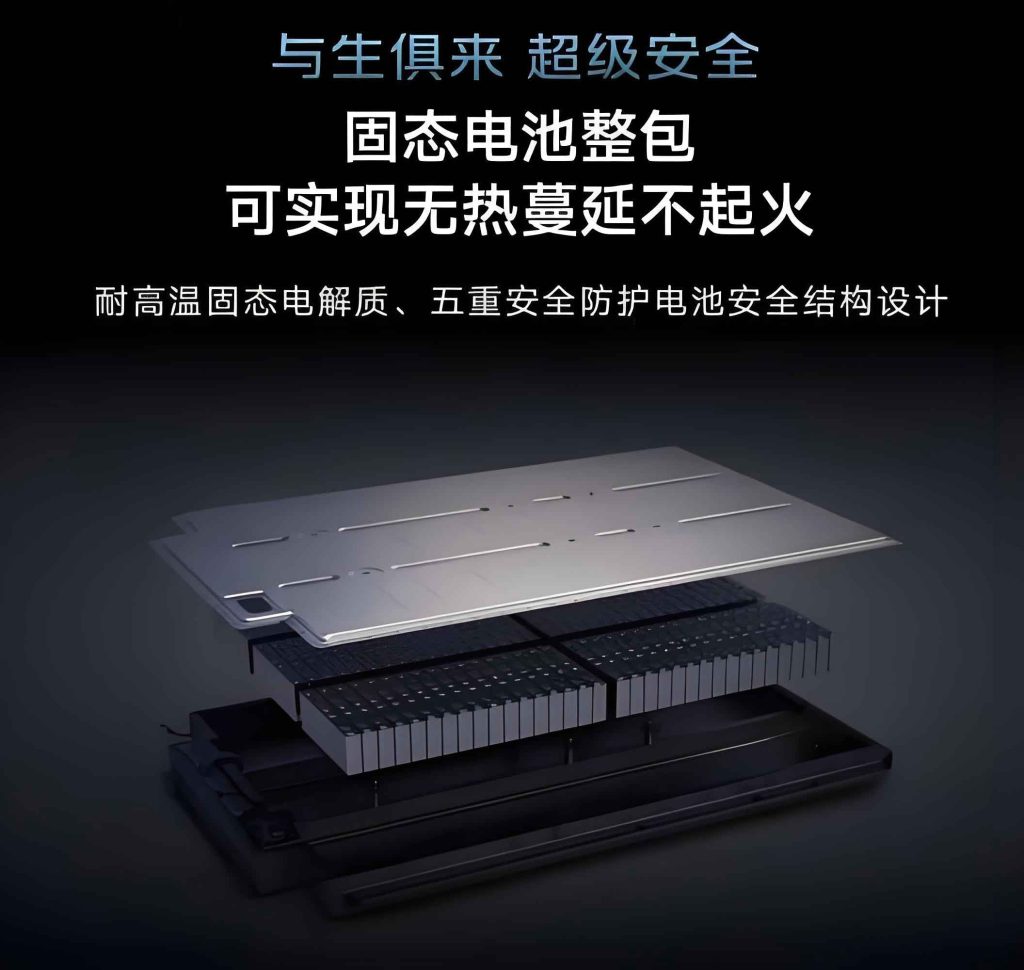
The table below provides a direct comparison between traditional lithium-ion batteries and all-solid-state lithium batteries, highlighting the fundamental architectural and performance differences.
| Category | All-Solid-State Lithium Battery | Traditional Lithium-ion Battery |
|---|---|---|
| Cell Structure | Cathode | Solid Electrolyte | Anode | Cathode | Liquid Electrolyte | Separator | Anode |
| Electrolyte Type | Inorganic Solid (Sulfide, Oxide, etc.) or Solid Polymer (e.g., PEO-based) | Organic Liquid Electrolyte (Carbonates + Li salts) or Gel Polymer Electrolyte |
| Key Advantages | High safety; Long cycle life; High energy density potential; Good high-temperature stability; Enables Li-metal anode. | High power density; Mature, low-cost manufacturing; Excellent performance for consumer electronics. |
| Key Challenges | Lower power density; High interfacial resistance; High cost; Manufacturing scalability. | Safety risks (leakage, fire); Limited electrochemical window; Liquid electrolyte degradation. |
The core of a solid-state battery is indisputably the solid-state electrolyte (SSE). An ideal SSE should exhibit: high lithium-ion conductivity at room temperature; negligible grain boundary resistance; matched thermal expansion coefficient with electrodes; excellent chemical and electrochemical stability against both cathode and lithium metal anode; a wide electrochemical stability window (>5.5 V vs. Li/Li+); moisture resistance; low cost; and simple processing. The development of SSEs can be categorized into polymer electrolytes and inorganic solid electrolytes, with the latter further divided into amorphous (glass), glass-ceramic, and crystalline ceramic types.
Polymer Solid-State Electrolytes
Polymer solid electrolytes are lithium-ion conductors composed of organic polymers and lithium salts. They offer advantages like light weight, easy film-forming capability, and good viscoelasticity. In a solid-state battery, they can enable high specific energy, power, and long cycle life across a wide temperature range. The polymer can also act as a separator, accommodate volume changes in electrodes, and to some extent, suppress lithium dendrite growth. Their flexibility is advantageous for large-scale roll-to-roll manufacturing. Poly(ethylene oxide) (PEO) complexed with lithium salts (e.g., LiTFSI) is the most studied system. Ion transport occurs primarily in the amorphous regions above the polymer’s glass transition temperature ($T_g$), following a Vogel-Tammann-Fulcher (VTF) type relationship:
$$
\sigma = \frac{A}{\sqrt{T}} \exp\left(\frac{-B}{T – T_0}\right)
$$
where $\sigma$ is conductivity, $T$ is temperature, and $A$, $B$, $T_0$ are constants. The primary challenges for PEO-based systems are low ionic conductivity at room temperature (typically ~10$^{-5}$ S/cm) and insufficient mechanical strength. Strategies to enhance performance include adding ceramic fillers (SiO$_2$, Al$_2$O$_3$, etc.) to form composite polymer electrolytes (CPEs), which improve mechanical stability, ionic conductivity, and interfacial properties, or synthesizing block copolymers and cross-linked networks.
Inorganic Solid-State Electrolytes
Inorganic SSEs offer high single-ion conductivity and excellent stability. Their use in all-solid-state batteries promises high thermal stability, non-flammability, and superior cycle life.
Amorphous (Glass) Electrolytes
Glass electrolytes offer isotropic ion conduction and relatively low interfacial resistance. Oxide glasses (e.g., Li$_2$O–P$_2$O$_5$–B$_2$O$_3$) have good stability but low room-temperature conductivity (~10$^{-6}$ S/cm). Sulfide glasses (e.g., Li$_2$S–SiS$_2$, Li$_2$S–P$_2$S$_5$) benefit from the larger, more polarizable S$^{2-}$ ion, achieving higher conductivities (~10$^{-4}$ to 10$^{-3}$ S/cm). Doping with LiI can further enhance conductivity but at the cost of electrochemical stability. A notable development is lithium phosphorous oxynitride (LiPON), a stable thin-film electrolyte with moderate conductivity (~10$^{-6}$ S/cm), widely used in micro-batteries.
Glass-Ceramic Electrolytes
Glass-ceramics are derived from glasses through controlled crystallization. They combine the high conductivity and good interfacial contact of glasses with the chemical stability of ceramics. For example, heat-treating Li$_2$S–P$_2$S$_5$ glass can yield a Li$_7$P$_3$S$_{11}$ glass-ceramic with conductivity exceeding 10$^{-3}$ S/cm. Oxide systems like Li$_{1+x}$Al$_x$Ti$_{2-x}$(PO$_4$)$_3$ (LATP) glass-ceramics also show promising conductivity (~10$^{-3}$ S/cm).
Crystalline Ceramic Electrolytes
These are polycrystalline materials with well-defined crystal structures that provide percolating pathways for Li$^+$ migration. Ionic conductivity ($\sigma$) follows an Arrhenius-type equation:
$$
\sigma T = A \exp\left(\frac{-E_a}{k_B T}\right)
$$
where $E_a$ is activation energy, $k_B$ is Boltzmann’s constant, and $A$ is a pre-exponential factor. The key families are:
| Electrolyte Family | Example Composition | Room-Temp $\sigma$ (S/cm) | Key Advantages | Major Challenges |
|---|---|---|---|---|
| NASICON-type | LATP, LAGP | ~10$^{-4}$ to 10$^{-3}$ | Good stability in air, high ionic conductivity. | Ti$^{4+}$ reducible by Li metal; high grain boundary resistance. |
| Perovskite-type | LLTO (Li$_{3x}$La$_{2/3-x}$TiO$_3$) | ~10$^{-3}$ (bulk) | Very high bulk ionic conductivity. | High grain boundary resistance; Ti$^{4+}$ reducible by Li metal. |
| Garnet-type | LLZO (Li$_7$La$_3$Zr$_2$O$_{12}$) | ~10$^{-4}$ to 10$^{-3}$ | High stability vs. Li metal; wide window. | Difficult sintering; reacts with air/H$_2$O; interfacial resistance. |
| Sulfide-type | LGPS (Li$_{10}$GeP$_2$S$_{12}$), argyrodites (Li$_6$PS$_5$Cl) | ~10$^{-2}$ to 10$^{-3}$ | Highest ionic conductivity (rivaling liquids). | Poor air stability (H$_2$S release); sensitive processing; cost. |
The ionic conductivity in these structures depends critically on the concentration of mobile Li$^+$ ions and vacancies, the connectivity of conduction pathways, and the size of the migration bottlenecks. For instance, in garnets, conductivity is optimized for a specific Li site occupancy. In sulfides like LGPS, the framework of (Ge/P)S$_4$ tetrahedra creates a 3D network with interconnected channels for rapid Li$^+$ transport.
The Critical Interface Challenge
Beyond the bulk properties of the solid electrolyte, the interfaces within a solid-state battery pose the most significant challenge. Unlike liquid electrolytes that wet surfaces, solid-solid contact is inherently poor. This leads to high interfacial resistance, which impedes power performance and can cause current focussing and dendrite initiation. The interfaces are also chemically and electrochemically dynamic. At the anode side, especially with lithium metal, the stability of the SSE is paramount. Many oxide electrolytes (LLTO, LATP) are reduced by Li. Even stable garnets like LLZO can form a passivating interphase. At the cathode, high-voltage oxides (NMC, NCA) can oxidize the electrolyte, especially sulfides. The volume changes of active materials during cycling can break contact, leading to rapid capacity fade. Therefore, a major focus of solid-state battery research is interface engineering. Strategies include:
- Introducing Interlayers: A soft buffer layer (e.g., a polymer, a compliant sulfide, or a thin metal film) between Li metal and a brittle ceramic electrolyte.
- Designing Composite Cathodes: The cathode is not a dense film but a composite mixture of active material, solid electrolyte, and conductive carbon. This provides continuous ionic and electronic pathways and accommodates volume change. The effective conductivity of such a composite ($\sigma_{eff}$) can be estimated by percolation theory or effective medium approximations.
- Surface Coating: Coating cathode particles with a thin, stable layer (e.g., LiNbO$_3$ on NMC) to prevent direct contact and side reactions with the SSE.
- Applying External Pressure: Stack pressure is often crucial to maintain intimate contact throughout cycling, adding complexity to cell design.
Pathways to Industrialization
The journey of the solid-state battery from the laboratory to mass-produced EV packs is expected to be incremental. Currently, material-level research dominates academic efforts. On the industrial side, numerous start-ups, established battery makers, and automotive OEMs are engaged in development. Japanese companies like Toyota have been particularly active, demonstrating prototype cells and vehicles with sulfide-based solid-state batteries. Other global players are pursuing diverse electrolyte paths (polymers, oxides, sulfides).
The manufacturing of a solid-state battery differs significantly from conventional lithium-ion production. Slurry casting of electrodes may be adapted for composite cathodes, but the solid electrolyte layer formation is key. Techniques include tape-casting, screen printing, physical vapor deposition (PVD for thin films), and cold or hot pressing. Assembly likely favors stacking over winding due to the brittleness of many solid electrolytes. The entire process must occur in a dry room environment, especially for moisture-sensitive sulfides. These factors currently contribute to high cost and scalability challenges.
Therefore, the commercialization of high-energy-density solid-state batteries is anticipated to occur in stages:
| Stage | Description | Timeline (Estimated) | Key Characteristic |
|---|---|---|---|
| Stage 1: Hybrid/Semi-Solid | Introduction of polymer or gel electrolytes, or small amounts of liquid/solid hybrid electrolytes to “wet” the interfaces. | Present – ~2025 | Improved safety over liquid, but not fully solid. Easier manufacturing integration. |
| Stage 2: All-Solid with Conversion Cathodes | Genuine all-solid-state cells using stabilized lithium metal anodes, but with conventional intercalation cathodes (NMC, LFP). | ~2025 – ~2030 | Major safety and energy density (350-450 Wh/kg) improvement. Solving interfacial and manufacturing challenges. |
| Stage 3: All-Solid with Revolutionary Chemistries | Integration of lithium metal anodes with ultra-high-capacity cathodes (sulfur, air) enabled by the solid electrolyte’s stability. | Post ~2030 | Ultimate energy density potential (>500 Wh/kg). Long-term research goal, dependent on solving profound scientific hurdles. |
In conclusion, the solid-state battery represents the most promising path to overcoming the critical limitations of current electric vehicle batteries. Its inherent safety and compatibility with high-energy electrodes like lithium metal position it as a transformative technology. While significant challenges remain—particularly concerning interfacial resistance, electrochemical stability, and cost-effective manufacturing—global research and industrial efforts are intensifying. The progression will likely be stepwise, from hybrid systems to full all-solid-state architectures. The successful development and deployment of the solid-state battery will be a pivotal milestone in the global transition to sustainable electric transportation.