
As a seasoned automotive repair technician specializing in new energy vehicles (NEVs), I have witnessed the rapid evolution of this industry driven by environmental concerns and energy crises. The electronic control system, as the core of NEVs, is pivotal for ensuring vehicle performance, safety, and efficiency. From my firsthand experience, maintaining these systems requires a deep understanding of their intricacies and a strategic approach to troubleshooting. In this article, I will delve into the characteristics of NEV electronic control systems, explore common故障类型, and propose application strategies for maintenance technologies, all while emphasizing the critical role of the motor control unit. I will use tables and formulas to summarize key points, aiming to enhance repair proficiency and adapt to future trends.
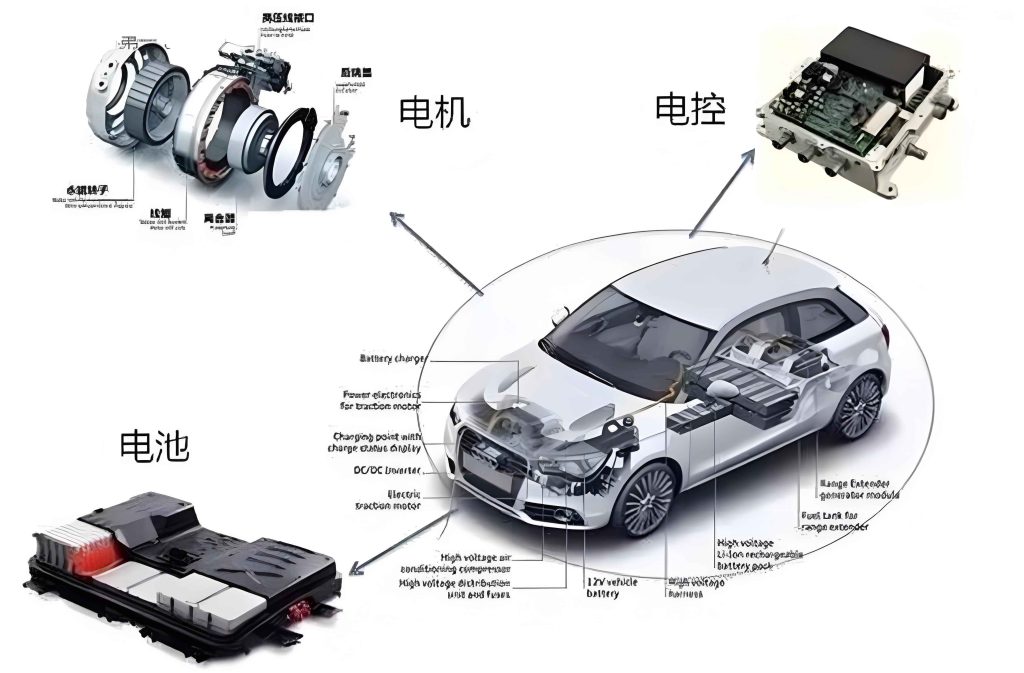
The electronic control system in NEVs is a sophisticated network that integrates multiple subsystems, such as the battery management system (BMS), motor control unit, and vehicle control unit (VCU). My work involves daily interactions with these components, and I have observed several defining features. First, the integration level is exceptionally high. For instance, the BMS not only monitors parameters like voltage, current, and temperature but also manages charging, discharging, and cell balancing. This compact design reduces space but complicates repairs, as isolating faults in interconnected modules can be challenging. Second, intelligence is paramount. Modern systems employ numerous sensors and algorithms to real-time monitor conditions and adjust control strategies. The motor control unit, for example, uses inputs from driver intent and road data to precisely regulate motor output, often represented by torque control equations. A basic formula for motor torque is: $$T = k_t \cdot I$$ where \(T\) is torque, \(k_t\) is the torque constant, and \(I\) is current. This intelligence extends to advanced driver-assistance systems, relying on accurate environmental perception. Third, the high-voltage system adds complexity and risk. NEV batteries typically operate at hundreds of volts, necessitating specialized equipment and safety protocols. Over time, components like cables and connectors may degrade, leading to insulation failures. From my perspective, these characteristics demand a proactive and knowledgeable maintenance approach.
In my repair practice, I encounter various fault types in electronic control systems. To organize these systematically, I have compiled a table based on my observations and diagnostic logs:
| Fault Category | Examples | Potential Impacts | Key Components Involved |
|---|---|---|---|
| Sensor Faults | Damage to temperature, humidity, or position sensors; inaccurate signal output | Erroneous data for BMS or motor control unit, affecting battery life or motor performance | Thermistors, Hall effect sensors |
| Controller Faults | Hardware failures (e.g., chip overheating), software bugs, compatibility issues | Malfunction in control strategies, such as incorrect torque commands from the motor control unit | Microcontrollers, FPGAs, embedded software |
| Actuator Faults | Motor failures, relay sticking, solenoid valve issues | Loss of vehicle动力, inability to start, or functional disruptions | Permanent magnet motors, power relays |
| Wiring Faults | Short circuits, open circuits, poor contacts due to vibration or wear | Signal transmission中断, leading to system errors or safety hazards | High-voltage cables, connectors, harnesses |
Sensor faults are frequent; for example, a faulty temperature sensor can mislead the BMS, causing battery overheat. The motor control unit relies on accurate sensor data for operations like field-oriented control, which can be modeled as: $$i_d = 0, \quad i_q = \frac{T}{k_t}$$ where \(i_d\) and \(i_q\) are direct and quadrature currents in dq-transform. Controller faults, especially in the motor control unit, often stem from thermal stress or software glitches post-update. Actuator faults, such as motor winding failures, directly impair vehicle movement. Wiring faults, though seemingly simple, can cascade into major issues, like short circuits triggering protection shutdowns.
To address these faults, I employ a multifaceted维修技术应用策略. First,故障诊断技术 combines traditional and advanced methods. Traditional techniques include visual inspection for obvious damage and multimeter measurements for electrical parameters. For instance, I might check a sensor’s resistance \(R\) against specifications: $$R = \frac{V}{I}$$ where \(V\) is voltage and \(I\) is current. Oscilloscopes are invaluable for analyzing signal waveforms from sensors linked to the motor control unit. Modern diagnostics leverage fault code reading via scan tools; these codes help pinpoint issues like a motor control unit communication error. Data analysis is also crucial—by examining BMS data logs, I can detect anomalies such as cell voltage imbalances using formulas like: $$\Delta V = V_{\text{max}} – V_{\text{min}}$$ where \(\Delta V\) should be minimal for healthy batteries. Big data tools allow predictive maintenance, identifying trends before failures occur.
Second,维修工具和设备的使用 is essential. I rely on specialized tools, summarized below:
| Tool Type | Purpose | Application Example | Notes |
|---|---|---|---|
| Professional Diagnostic Scanner | Read fault codes, data streams, program ECUs | Communicating with the motor control unit to recalibrate parameters | Brand-specific models required for不同车型 |
| High-Voltage Insulation Tester | Measure insulation resistance of HV systems | Ensuring safety before repairing battery packs or motor control unit circuits | Regular calibration needed; formula: $$R_{\text{ins}} = \frac{V_{\text{test}}}{I_{\text{leak}}}$$ |
| Oscilloscope and Signal Generator | Analyze and simulate electronic signals | Testing sensor inputs to the motor control unit for accuracy | Useful for frequency domain analysis |
| Thermal Imaging Camera | Detect overheating in controllers or actuators | Identifying hotspots in the motor control unit during stress tests | Prevents thermal runaway |
The motor control unit often requires precise diagnostics; for example, I might use an oscilloscope to verify PWM signals controlling motor speed, with duty cycle \(D\) given by: $$D = \frac{t_{\text{on}}}{T_{\text{period}}} \times 100\%$$ where \(t_{\text{on}}\) is on-time and \(T_{\text{period}}\) is total周期. Insulation testers ensure safe handling of high-voltage components, critical when accessing the motor control unit or battery terminals.
Third,维修人员的培训 is a cornerstone of effective maintenance. From my perspective, continuous learning is vital. Training should cover: (1)专业知识, such as电子电路 principles, motor control theories (e.g., vector control for the motor control unit), and BMS algorithms. I often refer to formulas like the back-EMF equation in motors: $$E = k_e \cdot \omega$$ where \(E\) is back-EMF, \(k_e\) is back-EMF constant, and \(\omega\) is angular velocity. (2)安全培训, focusing on high-voltage protocols—for instance, using insulated tools and following lockout-tagout procedures. (3)实践培训 through hands-on sessions with故障案例分析. I advocate for模拟实训 where technicians practice on actual NEVs, diagnosing issues like motor control unit failures under controlled conditions. A table can outline培训内容:
| Module | Topics | Duration | Outcome |
|---|---|---|---|
| Fundamentals | Basic electronics, NEV architecture, sensor types | 40 hours | Understand system layouts |
| Advanced Control | Motor control unit operation, PID algorithms, BMS logic | 60 hours | Diagnose controller faults |
| Safety Practices | HV safety, emergency response, PPE usage | 20 hours | Ensure risk-free repairs |
| Hands-on Labs | Fault simulation, tool application, data analysis | 80 hours | Develop practical skills |
Fourth,维修质量管理 ensures long-term reliability. I implement strategies like maintaining detailed repair records for each vehicle, documenting故障原因, replaced parts (e.g., a motor control unit swap), and test results. Quality inspections post-repair include functional tests—for example, validating the motor control unit response via dyno tests or road trials. Customer feedback loops help refine processes; I often use surveys to gather insights on repair satisfaction. Statistical process control can be applied, using formulas like defect rate \(p\): $$p = \frac{\text{Number of defective repairs}}{\text{Total repairs}} \times 100\%$$ aiming to minimize \(p\) over time.
Looking ahead,新能源汽车电控维修技术的发展趋势 are shaping my work. Remote diagnostics and online维修 are becoming prevalent; with IoT, I can access vehicle data in real-time to troubleshoot motor control unit issues without physical presence. Intelligent维修设备, such as AI-powered diagnostic robots, promise higher accuracy in fault identification. Green维修理念 emphasizes sustainability—for instance, remanufacturing motor control unit components or recycling batteries. These trends will revolutionize repair paradigms, reducing downtime and environmental impact.
In conclusion, from my experience as a technician, mastering NEV electronic control system maintenance requires a holistic strategy. By understanding system特点, leveraging advanced诊断技术, utilizing specialized tools, investing in培训, and enforcing质量管理, we can enhance repair efficacy. The motor control unit, as a central component, demands particular attention in all phases. As technology evolves, embracing trends like remote diagnostics and智能化维修 will be crucial for sustaining NEV performance and advancing the automotive industry. This proactive approach not only ensures vehicle reliability but also contributes to a greener future.