
As a researcher in the field of automotive electronics, I have observed the rapid evolution of new energy vehicles (NEVs) and the critical role played by their electronic control systems. These systems are the heart of vehicle operation, integrating multiple subsystems such as battery management, motor control, and energy management. Their complexity and integration pose significant challenges for fault diagnosis, which directly impacts vehicle safety and reliability. In this article, I will explore the structure, fault characteristics, and diagnostic technologies of NEV electronic control systems, with a focus on the motor control unit and other key components. I aim to provide a comprehensive overview that supports advancements in diagnostic techniques, leveraging tables and formulas to summarize key concepts.
The global shift toward sustainable transportation has accelerated the adoption of NEVs, driven by environmental concerns and energy transformation. The electronic control system, as the core control unit, coordinates the functions of various subsystems to ensure efficient and safe operation. However, its intricate design and high integration level make fault diagnosis increasingly difficult. Traditional methods often fall short, necessitating the development of more precise and efficient diagnostic technologies. In my analysis, I will delve into the architecture of these systems, examine common faults, and review diagnostic approaches like fault code analysis, data analytics, and pattern recognition. By incorporating real-world case studies and emphasizing the motor control unit, I hope to offer valuable insights for technicians and engineers.
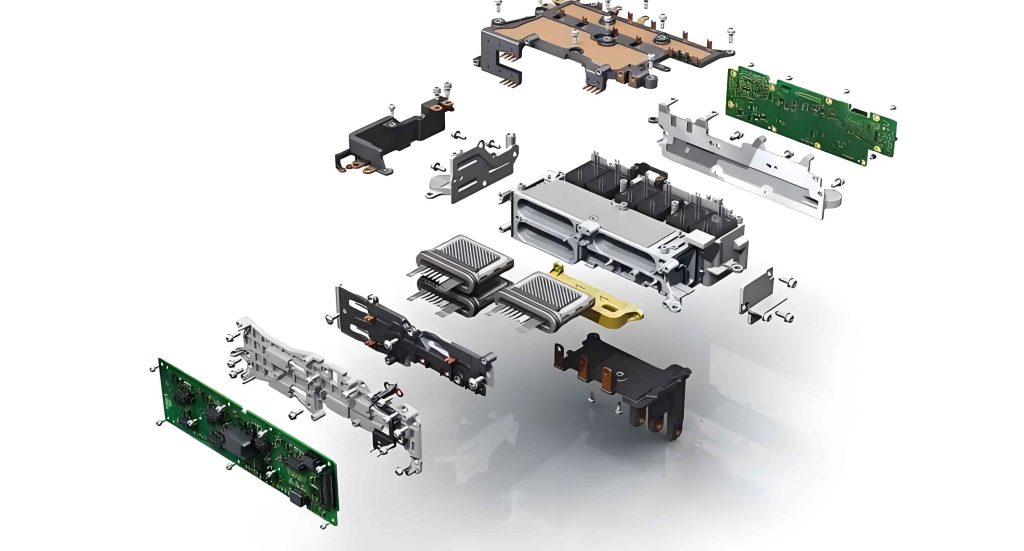
The electronic control system in NEVs employs a hierarchical distributed control architecture, which facilitates coordinated control through networked communication. At the top level, the vehicle control unit (VCU) acts as the central brain, managing power systems, safety systems, and comfort modules. This architecture ensures reliable operation under diverse driving conditions. The motor control unit, a critical subsystem, plays a pivotal role in converting electrical energy to mechanical power, directly influencing vehicle performance. Below, I present a table summarizing the key components and their functions within the NEV electronic control system.
| Subsystem | Acronym | Primary Function | Key Parameters Monitored |
|---|---|---|---|
| Battery Management System | BMS | Monitors battery voltage, current, temperature; manages state of charge (SOC) and thermal regulation | Cell voltage, temperature, SOC, state of health (SOH) |
| Motor Control Unit | MCU | Converts DC to AC for motor drive; controls torque and speed; enables energy recuperation | Motor torque, speed, phase currents, inverter temperature |
| Vehicle Control Unit | VCU | Coordinates overall vehicle strategy; manages power distribution and safety protocols | Driver input, vehicle speed, system status, fault flags |
| Power Distribution Unit | PDU | Distributes high-voltage power to various components; includes protection features | Voltage levels, current flow, insulation resistance |
The motor control unit is particularly vital, as it dictates the drivetrain’s responsiveness and efficiency. It relies on advanced algorithms to regulate the motor’s operation, often using field-oriented control (FOC) techniques. The torque output of the motor can be expressed using the following formula, which highlights the relationship between current and torque:
$$ T_e = \frac{3}{2} p \left( \psi_d i_q – \psi_q i_d \right) $$
where \( T_e \) is the electromagnetic torque, \( p \) is the number of pole pairs, \( \psi_d \) and \( \psi_q \) are the d- and q-axis flux linkages, and \( i_d \) and \( i_q \) are the d- and q-axis currents. This equation underscores the precision required in the motor control unit to maintain optimal performance. Any deviation in these parameters due to faults can lead to reduced efficiency or system failure.
In terms of system integration, the coordination among subsystems is achieved through communication networks like CAN (Controller Area Network) and LIN (Local Interconnect Network). The VCU processes data from the BMS and motor control unit to make real-time decisions. For instance, if the BMS detects an overheating battery, the VCU may limit the power output from the motor control unit to prevent damage. This interdependency means that faults can propagate quickly, making diagnostic systems essential for early detection. The table below outlines common communication protocols and their roles in NEV electronic control systems.
| Protocol | Speed | Primary Use | Typical Nodes |
|---|---|---|---|
| CAN Bus | High (up to 1 Mbps) | Real-time data exchange between core controllers (e.g., VCU, MCU, BMS) | VCU, MCU, BMS, PDU |
| LIN Bus | Low (up to 20 kbps) | Body control and human-machine interface functions | Door modules, lighting, climate control |
| Ethernet | Very High (up to 100+ Mbps) | Infotainment and advanced driver-assistance systems (ADAS) | Displays, sensors, telematics |
Faults in NEV electronic control systems can be categorized into hardware, software, and communication types. Hardware faults often stem from environmental stress or component wear, such as sensor drift or connector corrosion. The motor control unit, for example, may experience failures in its insulated-gate bipolar transistor (IGBT) modules due to thermal cycling. Software faults involve control algorithm errors or parameter mismatches, while communication faults arise from electromagnetic interference or wiring issues. These faults manifest in various ways, including reduced acceleration, charging interruptions, or safety system malfunctions. To quantify the impact, consider the battery SOC estimation, which is crucial for range prediction. The SOC can be calculated using a coulomb counting method:
$$ \text{SOC}(t) = \text{SOC}_0 – \frac{1}{C_n} \int_0^t \eta I(\tau) \, d\tau $$
where \( \text{SOC}(t) \) is the state of charge at time \( t \), \( \text{SOC}_0 \) is the initial SOC, \( C_n \) is the nominal capacity, \( \eta \) is the coulombic efficiency, and \( I(\tau) \) is the current. Faults in the BMS or sensors can skew this calculation, leading to inaccurate readings that affect the motor control unit’s power requests.
The need for advanced diagnostic technologies is paramount. Traditional fault code diagnosis, based on standards like ISO 14229, provides a baseline but struggles with complex or intermittent faults. Modern approaches leverage data analytics and machine learning to identify patterns and predict failures. For instance, by analyzing time-series data from the motor control unit, such as current waveforms and temperature trends, anomalies can be detected early. I have compiled a table comparing different diagnostic techniques to highlight their strengths and limitations.
| Technique | Description | Advantages | Challenges |
|---|---|---|---|
| Fault Code Diagnosis | Uses standardized DTCs from OBD systems for fault identification | Quick initial localization; widely supported | Limited to predefined codes; may miss complex faults |
| Data Analytics | Analyzes historical and real-time data to detect deviations from normal behavior | Enables predictive maintenance; handles large datasets | Requires extensive data collection; computationally intensive |
| Pattern Recognition | Employs machine learning algorithms to classify fault patterns based on training data | High accuracy for known faults; adapts to new patterns | Needs labeled data; model training can be time-consuming |
| Intelligent Diagnosis | Integrates AI, edge computing, and digital twins for real-time, adaptive diagnostics | Real-time detection; handles complex fault chains | High implementation cost; requires robust infrastructure |
Focusing on the motor control unit, its fault diagnosis often involves monitoring key performance indicators. For example, the efficiency of the motor drive system can be expressed as:
$$ \eta = \frac{P_{\text{out}}}{P_{\text{in}}} = \frac{T \omega}{V I} $$
where \( \eta \) is the efficiency, \( P_{\text{out}} \) is the output power (torque \( T \) times angular velocity \( \omega \)), and \( P_{\text{in}} \) is the input power (voltage \( V \) times current \( I \)). A drop in efficiency may indicate faults in the motor control unit, such as switching losses or winding insulation breakdown. By continuously tracking these parameters, diagnostic systems can flag issues before they escalate.
In practice, data analytics diagnosis has proven effective for battery health assessment. By analyzing charge-discharge cycles and internal resistance trends, the BMS can predict remaining useful life. Similarly, for the motor control unit, techniques like Fourier analysis of current signals help identify harmonics caused by faulty power electronics. The integration of these methods with cloud platforms allows for fleet-wide learning, where diagnostic models improve over time based on aggregated data. This is especially relevant for the motor control unit, as operational data from multiple vehicles can reveal common failure modes related to driving patterns or environmental conditions.
Looking ahead, intelligent diagnostic technologies are set to revolutionize NEV maintenance. Machine learning algorithms, such as convolutional neural networks (CNNs) or recurrent neural networks (RNNs), can process multidimensional data from the motor control unit and other subsystems to detect subtle anomalies. Edge computing enables on-board real-time analysis, reducing latency, while digital twins create virtual replicas for simulation and testing. These advancements support a shift from reactive to predictive diagnostics, enhancing vehicle safety and uptime. For example, a digital twin of the motor control unit can simulate thermal stress under different loads, helping to design more robust fault detection rules.
To illustrate the complexity of fault interactions, consider a scenario where a fault in the motor control unit leads to torque fluctuations. This may trigger the VCU to limit power, affecting the BMS’s discharge rate. Such chain reactions emphasize the need for holistic diagnostic approaches. I propose a framework that combines model-based and data-driven methods, where physical models of the motor control unit (e.g., using differential equations for motor dynamics) are fused with sensor data to improve fault isolation. The equation for motor dynamics can be represented as:
$$ J \frac{d\omega}{dt} = T_e – T_l – B\omega $$
where \( J \) is the moment of inertia, \( \omega \) is the angular velocity, \( T_e \) is the electromagnetic torque from the motor control unit, \( T_l \) is the load torque, and \( B \) is the viscous friction coefficient. Deviations from expected values in this model can signal faults.
In conclusion, the evolution of fault diagnosis for NEV electronic control systems is crucial for ensuring safe and reliable transportation. Through a deep understanding of system architecture, fault characteristics, and emerging technologies like AI-driven analytics, we can develop more effective diagnostic solutions. The motor control unit, as a central component, deserves particular attention due to its impact on vehicle performance. By leveraging tables, formulas, and case studies, this article aims to contribute to the ongoing efforts in this field. As technology advances, I believe that integrated, intelligent diagnostic systems will become standard, paving the way for smarter and more resilient NEVs.
To further elaborate on diagnostic techniques, let’s consider the role of signal processing in the motor control unit. Vibration analysis, for instance, can detect bearing faults in the motor by examining frequency spectra. The power spectral density (PSD) of vibration signals can reveal peaks at characteristic frequencies, calculated as:
$$ \text{PSD}(f) = \lim_{T \to \infty} \frac{1}{T} \left| \int_{-T/2}^{T/2} x(t) e^{-j2\pi ft} \, dt \right|^2 $$
where \( x(t) \) is the vibration signal and \( f \) is the frequency. Integrating such methods with the motor control unit’s control algorithms allows for continuous health monitoring.
Another aspect is the thermal management of the motor control unit. Overheating can degrade components, so temperature monitoring is vital. The heat dissipation can be modeled using Newton’s law of cooling:
$$ \frac{dT}{dt} = -\frac{hA}{mc} (T – T_{\text{env}}) + \frac{P_{\text{loss}}}{mc} $$
where \( T \) is the temperature, \( h \) is the heat transfer coefficient, \( A \) is the surface area, \( m \) is the mass, \( c \) is the specific heat, \( T_{\text{env}} \) is the ambient temperature, and \( P_{\text{loss}} \) is the power loss in the motor control unit. By predicting temperature rises, diagnostic systems can preemptively adjust cooling strategies.
In terms of implementation, diagnostic systems often use a layered approach. At the sensor level, simple checks validate data plausibility; at the controller level, algorithms like parity checks or observers detect discrepancies; and at the system level, data fusion techniques correlate information across subsystems. For the motor control unit, this might involve comparing commanded torque with actual torque feedback to identify sensor biases or actuator faults. The residual error \( r(t) \) can be defined as:
$$ r(t) = T_{\text{cmd}}(t) – T_{\text{meas}}(t) $$
where \( T_{\text{cmd}} \) is the torque command from the motor control unit and \( T_{\text{meas}} \) is the measured torque. Statistical analysis of \( r(t) \) over time can reveal fault patterns.
Furthermore, standardization efforts, such as AUTOSAR (Automotive Open System Architecture), facilitate diagnostic services by defining common software components. This is beneficial for the motor control unit, as it ensures interoperability with other ECUs. However, the increasing software complexity also introduces new fault modes, like timing violations or memory leaks, which require specialized diagnostic tools.
To address these challenges, research is exploring adaptive diagnostics that learn from operational data. Reinforcement learning, for example, can optimize diagnostic policies for the motor control unit by rewarding accurate fault detections and minimizing false alarms. The reward function \( R \) might be formulated as:
$$ R = \alpha \cdot \text{TPR} – \beta \cdot \text{FPR} – \gamma \cdot \text{cost} $$
where TPR is the true positive rate, FPR is the false positive rate, cost represents computational or operational expenses, and \( \alpha, \beta, \gamma \) are weighting factors. Such approaches make diagnostics more efficient and tailored to specific vehicle models.
In summary, the journey toward robust fault diagnosis in NEV electronic control systems involves multidisciplinary efforts. From the hardware resilience of the motor control unit to the software intelligence of diagnostic algorithms, every aspect contributes to overall reliability. By embracing new technologies and fostering collaboration across industry and academia, we can overcome current limitations and pave the way for a future where NEVs are not only cleaner but also smarter and safer. I hope this discussion inspires further innovation in this vital area.